What does the NESTS acronym stand for in relation to supply shifts?
NESTS stands for Nature, Expectations of future prices (hiring), Subsidies, Technology, and Number of suppliers, all of which directly increase supply.
How does a positive event in nature affect supply?
A positive event in nature increases supply, while a negative event decreases supply.
What happens to supply when producers expect higher future prices and hire more workers?
Supply increases because producers expand production in anticipation of higher future prices.
How do subsidies affect the supply of a good?
An increase in subsidies raises the supply of a good by lowering production costs.
What is the effect of improved technology on supply?
Improved technology generally increases supply by making production more efficient.
How does an increase in the number of suppliers impact supply?
An increase in the number of suppliers leads to an increase in the overall market supply.
What does the SITE acronym represent for supply shifts?
SITE stands for Substitute in production, Input prices, Taxes, and Expectations (storage), all of which inversely affect supply.
How does an increase in the price of a substitute in production affect supply?
If the price of a substitute in production rises, the supply of the original good decreases as producers switch to making the substitute.
What is the effect of rising input prices on supply?
Rising input prices decrease supply because production becomes more expensive.
How do higher taxes influence the supply of a good?
Higher taxes decrease supply by increasing the cost of production.
What happens to supply when producers expect higher future prices and store goods?
Supply decreases in the present as producers store goods to sell later at higher prices.
Does a change in price shift the supply curve?
No, a change in price causes movement along the supply curve, not a shift of the curve.
What is the difference between a movement along the supply curve and a shift of the supply curve?
A movement along the supply curve is caused by a change in price, while a shift is caused by non-price factors.
Why is it important to distinguish between price changes and supply shifts on exams?
Because confusing the two can lead to incorrect answers, as only non-price factors shift the supply curve.
What study strategy is recommended when first learning supply and demand shifts?
Keep a summary sheet of all shifts handy for reference until you become comfortable with the concepts.
 Back
Back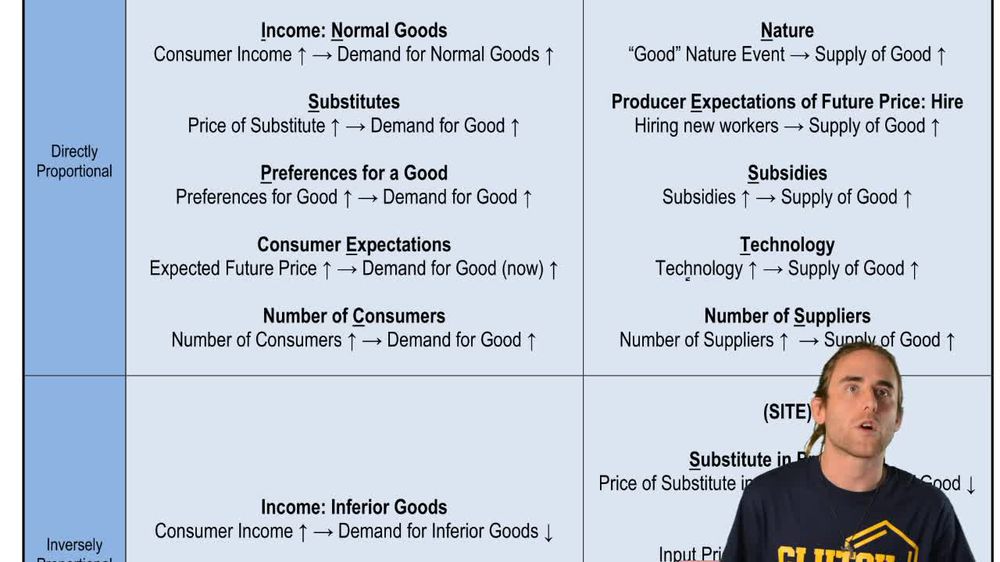
 04:05
04:05