Back

AD-AS Model: Shifts in Aggregate Demand quiz

Control buttons has been changed to "navigation" mode.
1/15
  • What are the three steps to analyze a shift in aggregate demand in the AD-AS model?

    First, shift the aggregate demand curve; second, find the new short-run equilibrium; third, adjust the short-run aggregate supply to achieve a new long-run equilibrium.
  • What happens to the aggregate demand curve when investment spending decreases?

    The aggregate demand curve shifts to the left, leading to lower price levels and GDP in the short run.
  • Which components make up aggregate demand?

    Aggregate demand consists of consumption, investment, government purchases, and net exports.
  • What is the effect of a decrease in aggregate demand on short-run equilibrium price and GDP?

    Both the price level and GDP decrease in the short-run equilibrium.
  • How does the short-run aggregate supply curve react to a leftward shift in aggregate demand?

    The short-run aggregate supply curve shifts to the right to restore long-run equilibrium.
  • What is the result in the long run after a decrease in aggregate demand and subsequent supply adjustment?

    The economy returns to its original long-run GDP but at a lower price level.
  • What causes demand-pull inflation in the AD-AS model?

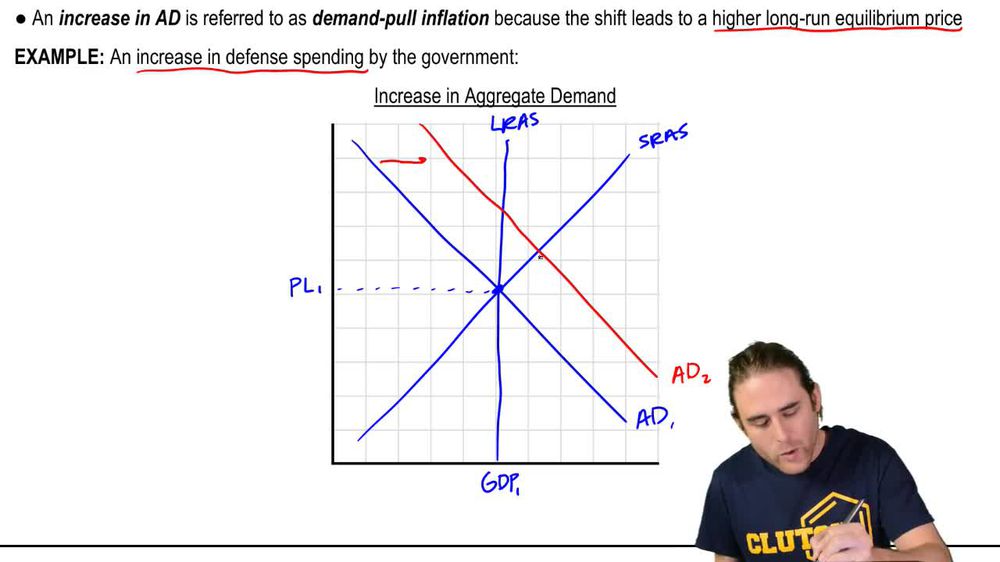
    An increase in aggregate demand, such as higher government spending, causes demand-pull inflation by raising prices.
  • What happens to the aggregate demand curve when government spending increases?

    The aggregate demand curve shifts to the right, resulting in higher prices and GDP in the short run.
  • What is the effect of an increase in aggregate demand on short-run equilibrium GDP?

    Short-run equilibrium GDP temporarily exceeds the long-run equilibrium GDP, reflecting a 'hot' economy.
  • How does the short-run aggregate supply curve react to a rightward shift in aggregate demand?

    The short-run aggregate supply curve shifts to the left to return the economy to its long-run equilibrium.
  • After an increase in aggregate demand and supply adjustment, what happens to long-run equilibrium price and GDP?

    Long-run equilibrium GDP returns to its original level, but the price level is higher.
  • Why does the short-run aggregate supply shift in the opposite direction of aggregate demand?

    It shifts oppositely to restore the economy to its long-run equilibrium after a demand shock.
  • What is meant by 'temporary overshooting' of long-run GDP in the AD-AS model?

    It refers to short-run GDP exceeding long-run equilibrium due to increased aggregate demand before supply adjusts.
  • What is the role of the long-run aggregate supply curve during shifts in aggregate demand?

    The long-run aggregate supply curve remains constant, representing the economy's potential output.
  • What happens to price levels in the long run after a negative aggregate demand shock?

    Price levels decrease in the long run, while GDP returns to its original equilibrium.