Table of contents
- 1. Introduction to Macroeconomics
- 2. Introductory Economic Models
- 3. Supply and Demand
- Introduction to Supply and Demand
- The Basics of Demand
- Individual Demand and Market Demand
- Shifting Demand
- The Basics of Supply
- Individual Supply and Market Supply
- Shifting Supply
- Overview of Supply and Demand Shifts
- Supply and Demand Together: Equilibrium, Shortage, and Surplus
- Supply and Demand Together: One-sided Shifts
- Supply and Demand Together: Both Shift
- Supply and Demand: Quantitative Analysis
- 4. Elasticity
- Percentage Change and Price Elasticity of Demand
- Elasticity and the Midpoint Method
- Price Elasticity of Demand on a Graph
- Determinants of Price Elasticity of Demand
- Total Revenue Test
- Total Revenue Along a Linear Demand Curve
- Income Elasticity of Demand
- Cross-Price Elasticity of Demand
- Price Elasticity of Supply
- Price Elasticity of Supply on a Graph
- Elasticity Summary
- 5. Consumer and Producer Surplus; Price Ceilings and Price Floors
- WIllingness to Pay and Consumer Surplus
- Willingness to Sell and Producer Surplus
- Economic Surplus and Efficiency
- Quantitative Analysis of Consumer and Producer Surplus at Equilibrium
- Price Ceilings, Price Floors, and Black Markets
- Quantitative Analysis of Price Ceilings and Floors: Finding Points
- Quantitative Analysis of Price Ceilings and Floors: Finding Areas
- 6. Introduction to Taxes
- 7. Externalities
- 8. The Types of Goods
- 9. International Trade
- Introducing Economic Concepts
- 10. Measuring National Output and Income
- 11. Unemployment and Inflation
- Labor Force and Unemployment
- Types of Unemployment
- Unemployment: Minimum Wage Laws and Efficiency Wages
- Inflation and Consumer Price Index (CPI)
- Using CPI to Adjust for Inflation
- Problems with the Consumer Price Index (CPI)
- Nominal Income and Real Income
- Nominal Interest, Real Interest, and the Fisher Equation
- Who is Affected by Inflation?
- Demand-Pull and Cost-Push Inflation
- Costs of Inflation: Shoe-leather Costs and Menu Costs
- 12. Productivity and Economic Growth
- 13. The Financial System
- 14. Income and Consumption
- 15. Deriving the Aggregate Expenditures Model
- 16. Aggregate Demand and Aggregate Supply Analysis
- 17. The Monetary System
- 18. Monetary Policy
- 19. Fiscal Policy
- 20. Tradeoffs Between Inflation and Unemployment
- 21. Open-Economy Macroeconomics
- Balance of Payments: Introduction
- Balance of Payments: Current Account
- Balance of Payments: Financial Account and Capital Account
- Net Exports Equal Net Foreign Investment
- Balance of Trade; Trade Deficit and Trade Surplus
- Exchange Rates: Introduction
- Exchange Rates: Nominal and Real
- Exchange Rates: Equilibrium
- Exchange Rates: Shifts in Supply and Demand
- Exchange Rates and Net Exports
- Exchange Rates: Purchasing Power Parity
- The Gold Standard
- The Bretton Woods System
- Exchange Rates
- 22. Macroeconomic Schools of Thought
- 23. Dynamic AD/AS Model
- Special Topics
- The Costs of Production (MICROECONOMICS)
- Perfect Competition (MICROECONOMICS)
- Introduction to the Four Market Models
- Characteristics of Perfect Competition
- Revenue in Perfect Competition
- Perfect Competition Profit on the Graph
- Short Run Shutdown Decision
- Long Run Entry and Exit Decision
- Individual Supply Curve in the Short Run and Long Run
- Market Supply Curve in the Short Run and Long Run
- Long Run Equilibrium
- Perfect Competition and Efficiency
- Four Market Model Summary: Perfect Competition
- Monopoly (MICROECONOMICS)
- Monopolistic Competition (MICROECONOMICS)
- Oligopoly (MICROECONOMICS)
- Markets for the Factors of Production (MICROECONOMICS)
- Income Inequality and Poverty (MICROECONOMICS)
- Asymmetric Information, Voting, and Public Choice (MICROECONOMICS)
- Consumer Choice and Behavioral Economics (MICROECONOMICS)
Asymmetric Information, Voting, and Public Choice (MICROECONOMICS)
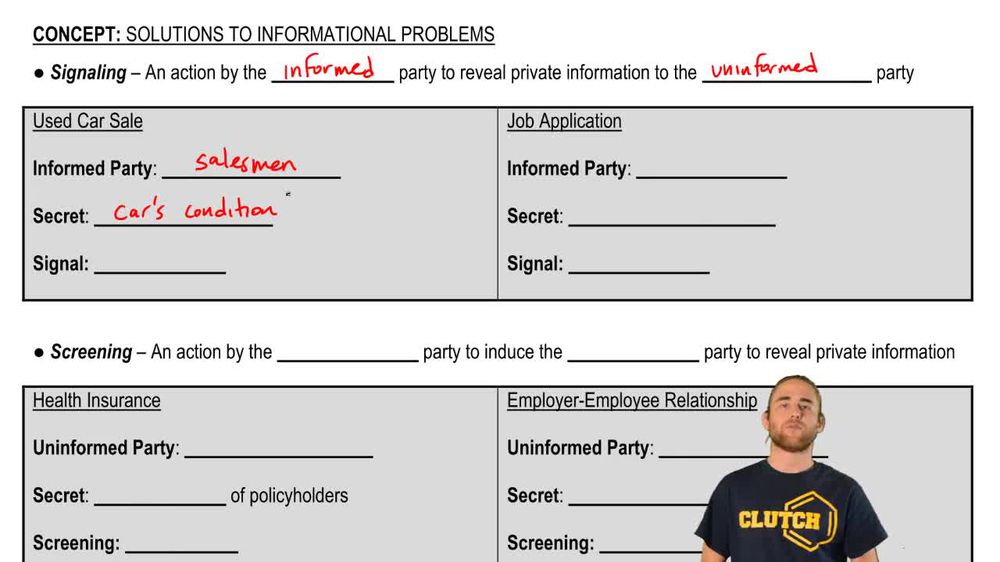
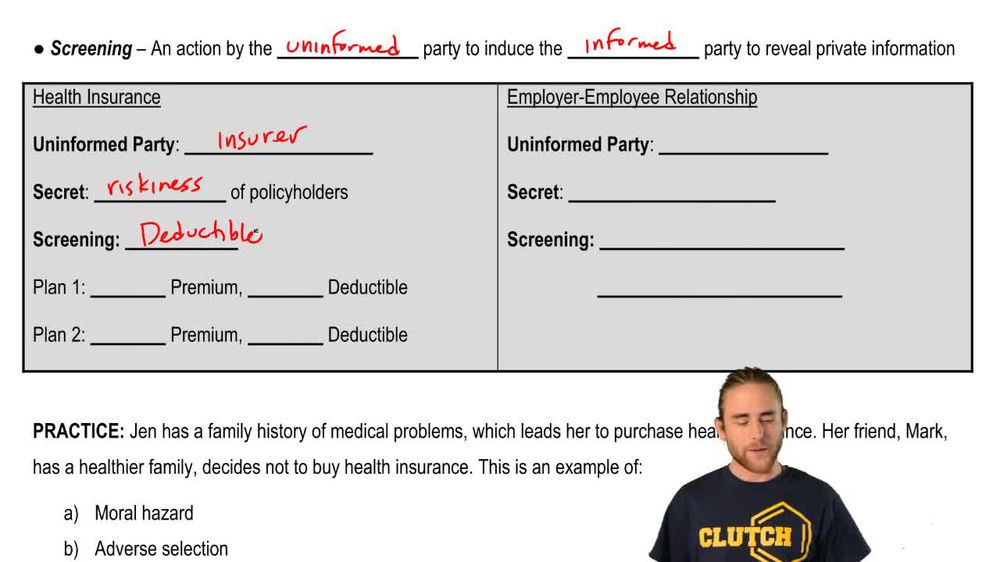
Solutions to Informational Problems
Asymmetric Information, Voting, and Public Choice (MICROECONOMICS)
Solutions to Informational Problems
 03:06
03:06

Practice this topic
- Multiple Choice
Jen has a family history of medical problems, which leads her to purchase health insurance. Her friend, Mark, has a healthier family, decides not to buy health insurance. This is an example of:
- Multiple Choice
Safe Times Insurance requires a medical examination for all applicants for medical insurance. Those with significant preexisting conditions are charged more. This is an example of: