Skip to main content
Introduction to Chemistry
My Course
Learn
Exam Prep
AI Tutor
Study Guides
Flashcards
Explore
Try the app
My Course
Learn
Exam Prep
AI Tutor
Study Guides
Flashcards
Explore
Try the app
Back
Positron Emission quiz
You can tap to flip the card.
What is positron emission?
You can tap to flip the card.
👆
What is positron emission?
Positron emission occurs when an unstable nucleus emits a positron, which is a product of nuclear decay.
Track progress
Control buttons has been changed to "navigation" mode.
1/15
Related flashcards
Related practice
Recommended videos
Positron Emission definitions
Positron Emission
12 Terms
Positron Emission
17. Radioactivity and Nuclear Chemistry
5 problems
Topic
Radioactive Half-Life
17. Radioactivity and Nuclear Chemistry
5 problems
Topic
17. Radioactivity and Nuclear Chemistry
7 topics
20 problems
Chapter
Guided course
02:33
Positron Emission Example 2
6
views
Guided course
01:00
Positron Emission Example 1
3
views
Guided course
01:54
Positron Emission Concept 1
2
views
Terms in this set (15)
Hide definitions
What is positron emission?
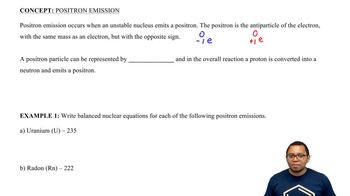
Positron emission occurs when an unstable nucleus emits a positron, which is a product of nuclear decay.
What is a positron?
A positron is the antiparticle of the electron; it has the same mass as an electron but a positive charge.
How does a positron differ from an electron?
A positron has a positive charge, while an electron has a negative charge.
What does the term 'emission' mean in positron emission?
Emission means decay, indicating that the positron is released as a product during nuclear decay.
What happens to the atomic number during positron emission?
The atomic number decreases by 1 after positron emission.
What happens to the atomic mass during positron emission?
The atomic mass remains unchanged during positron emission.
What is the symbol for a positron?
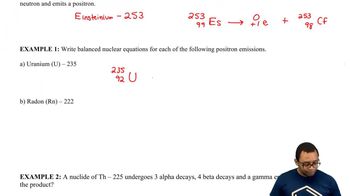
The symbol for a positron is 0/+1 e.
Which element is used as an example for positron emission in the lesson?
Einsteinium (Es) with atomic number 99 and mass number 253 is used as an example.
What is the atomic number of Einsteinium before positron emission?
The atomic number of Einsteinium before positron emission is 99.
What is the atomic mass of Einsteinium in the example?
The atomic mass of Einsteinium in the example is 253.
What element is formed after Einsteinium emits a positron?
Californium (Cf) with atomic number 98 is formed after positron emission.
How do you determine the new atomic number after positron emission?
Subtract 1 from the original atomic number to get the new atomic number.
Does the mass number change during positron emission?
No, the mass number stays the same during positron emission.
What is the charge of a positron?
A positron has a positive charge.
Why is positron emission considered a nuclear reaction?
Positron emission involves changes in the nucleus, which is characteristic of nuclear reactions.
 BackBack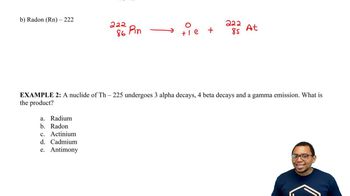
 02:33
02:33