Skip to main content
Introduction to Chemistry
My Course
Learn
Exam Prep
AI Tutor
Study Guides
Flashcards
Explore
Try the app
My Course
Learn
Exam Prep
AI Tutor
Study Guides
Flashcards
Explore
Try the app
Back
Positron Emission definitions
You can tap to flip the card.
Positron
You can tap to flip the card.
👆
Positron
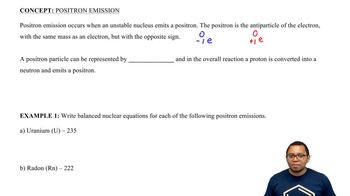
An antiparticle of the electron, identical in mass but carrying a positive charge instead of a negative one.
Track progress
Control buttons has been changed to "navigation" mode.
1/12
Related flashcards
Related practice
Recommended videos
Positron Emission quiz
Positron Emission
15 Terms
Positron Emission
17. Radioactivity and Nuclear Chemistry
5 problems
Topic
Radioactive Half-Life
17. Radioactivity and Nuclear Chemistry
5 problems
Topic
17. Radioactivity and Nuclear Chemistry
7 topics
21 problems
Chapter
Guided course
02:33
Positron Emission Example 2
5
views
Guided course
01:00
Positron Emission Example 1
3
views
Guided course
01:54
Positron Emission Concept 1
2
views
Terms in this set (12)
Hide definitions
Positron
An antiparticle of the electron, identical in mass but carrying a positive charge instead of a negative one.
Antiparticle
A subatomic entity with the same mass as its counterpart but with opposite charge or quantum properties.
Electron
A subatomic particle with a negative charge, commonly found in atomic orbitals.
Nuclear Reaction
A process involving changes in an atom's nucleus, often resulting in the transformation of elements.
Emission
The process by which a nucleus releases a particle, often as a product of radioactive decay.
Decay
A spontaneous transformation of an unstable nucleus, leading to the release of particles or energy.
Isotope
Atoms of the same element with identical atomic numbers but differing in mass numbers due to varying neutrons.
Atomic Number
The count of protons in an atom's nucleus, determining the element's identity on the periodic table.
Atomic Mass
The total number of protons and neutrons present in an atom's nucleus.
Einsteinium
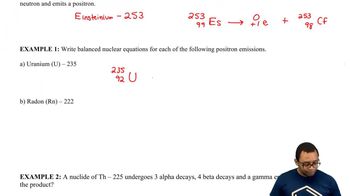
A synthetic element with atomic number 99, named after Albert Einstein, symbolized as Es.
Californium
A synthetic element with atomic number 98, produced from the decay of heavier elements, symbolized as Cf.
Product
A substance formed as a result of a chemical or nuclear reaction, appearing on the right side of an equation.
 BackBack
 02:33
02:33