Skip to main content
Introduction to Chemistry
My Course
Learn
Exam Prep
AI Tutor
Study Guides
Flashcards
Explore
Try the app
My Course
Learn
Exam Prep
AI Tutor
Study Guides
Flashcards
Explore
Try the app
Back
Periodic Trend: Atomic Radius (Simplified) quiz #1
You can tap to flip the card.
How is the periodic table arranged with respect to atomic radius trends?
You can tap to flip the card.
👆
How is the periodic table arranged with respect to atomic radius trends?
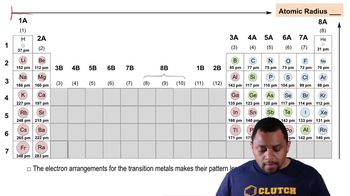
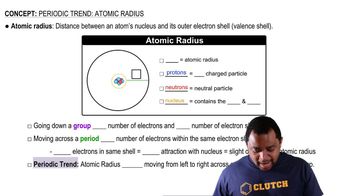
The periodic table is arranged so that atomic radius increases down a group and decreases from left to right across a period.
Track progress
Control buttons has been changed to "navigation" mode.
1/13
Related flashcards
Related practice
Recommended videos
Periodic Trend: Atomic Radius (Simplified) definitions
Periodic Trend: Atomic Radius (Simplified)
14 Terms
Periodic Trend: Atomic Radius (Simplified)
9. Electrons in Atoms and the Periodic Table
5 problems
Topic
Periodic Trend: Ionization Energy (Simplified)
9. Electrons in Atoms and the Periodic Table
5 problems
Topic
9. Electrons in Atoms and the Periodic Table - Part 3 of 4
12 topics
36 problems
Chapter
Guided course
01:07
Periodic Trend: Atomic Radius (Simplified) Example 1
4
views
Guided course
01:06
Periodic Trend: Atomic Radius (Simplified) Concept 2
3
views
Guided course
02:02
Periodic Trend: Atomic Radius (Simplified) Concept 1
7
views
1
rank
Terms in this set (13)
Hide definitions
How is the periodic table arranged with respect to atomic radius trends?
The periodic table is arranged so that atomic radius increases down a group and decreases from left to right across a period.
Which element generally has the largest atomic radius based on periodic trends?
The element located at the bottom left of the periodic table generally has the largest atomic radius.
Which atom is generally the smallest according to periodic trends?
The atom located at the top right of the periodic table (excluding noble gases) is generally the smallest.
In the compound KBr, which ion is larger: K⁺ or Br⁻?
Br⁻ is larger than K⁺ because anions are generally larger than cations, and atomic radius increases down a group.
Is mercury a heavier element than tin?
Yes, mercury is a heavier element than tin because it is located further down the periodic table.
Which element has the smallest atomic radius according to periodic trends?
The element at the top right of the periodic table (excluding noble gases), such as fluorine, has the smallest atomic radius.
Which element has the smallest atomic radius?
The element at the top right of the periodic table (excluding noble gases) has the smallest atomic radius.
Which atom has the largest atomic radius?
The atom at the bottom left of the periodic table has the largest atomic radius.
Which element has the greatest atomic radius?
The element at the bottom left of the periodic table has the greatest atomic radius.
Which element has the smallest radius?
The element at the top right of the periodic table (excluding noble gases) has the smallest radius.
Which property increases as you move down the periodic table?
Atomic radius increases as you move down the periodic table.
Which element has the highest atomic radius?
The element at the bottom left of the periodic table has the highest atomic radius.
Which atom has the smallest atomic radius?
The atom at the top right of the periodic table (excluding noble gases) has the smallest atomic radius.
 BackBack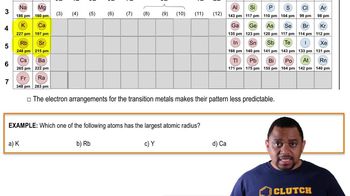
 01:07
01:07