Skip to main content
Introduction to Chemistry
My Course
Learn
Exam Prep
AI Tutor
Study Guides
Flashcards
Explore
Try the app
My Course
Learn
Exam Prep
AI Tutor
Study Guides
Flashcards
Explore
Try the app
Back
Periodic Trend: Atomic Radius (Simplified) definitions
You can tap to flip the card.
Atomic Radius
You can tap to flip the card.
👆
Atomic Radius
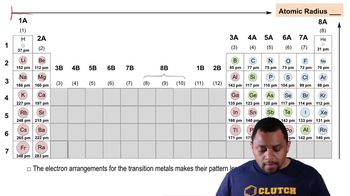
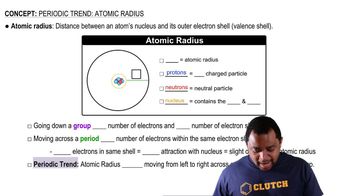
Distance from the center of the nucleus to the outermost electron shell, indicating the overall size of an atom.
Track progress
Control buttons has been changed to "navigation" mode.
1/14
Related flashcards
Related practice
Recommended videos
Periodic Trend: Atomic Radius (Simplified) quiz #1
Periodic Trend: Atomic Radius (Simplified)
13 Terms
Periodic Trend: Atomic Radius (Simplified)
9. Electrons in Atoms and the Periodic Table
5 problems
Topic
Periodic Trend: Ionization Energy (Simplified)
9. Electrons in Atoms and the Periodic Table
5 problems
Topic
9. Electrons in Atoms and the Periodic Table - Part 3 of 4
12 topics
36 problems
Chapter
Guided course
01:07
Periodic Trend: Atomic Radius (Simplified) Example 1
4
views
Guided course
01:06
Periodic Trend: Atomic Radius (Simplified) Concept 2
3
views
Guided course
02:02
Periodic Trend: Atomic Radius (Simplified) Concept 1
7
views
1
rank
Terms in this set (14)
Hide definitions
Atomic Radius
Distance from the center of the nucleus to the outermost electron shell, indicating the overall size of an atom.
Nucleus
Central region of an atom containing protons and neutrons, responsible for most of the atom's mass.
Proton
Positively charged particle found within the nucleus, contributing to the atom's identity and charge.
Neutron
Neutral particle located in the nucleus, adding to atomic mass but not affecting charge.
Valence Shell
Outermost electron shell of an atom, determining chemical reactivity and atomic radius.
Electron Shell
Energy level surrounding the nucleus where electrons are likely to be found.
Group
Vertical column on the periodic table where elements share similar properties and electron shell patterns.
Period
Horizontal row on the periodic table, indicating elements with the same number of electron shells.
Transition Metal
Element found in the central block of the periodic table, often showing unpredictable atomic radius trends.
Periodic Trend
Predictable pattern observed in element properties as one moves across or down the periodic table.
Electron
Negatively charged particle occupying shells around the nucleus, influencing atomic size and reactivity.
Attraction
Force drawing electrons toward the nucleus, affecting the size of the atomic radius.
Top Right Corner
Region of the periodic table where elements typically have the smallest atomic radii.
Exception
Case where a general trend does not apply, often due to unique electron arrangements.
 BackBack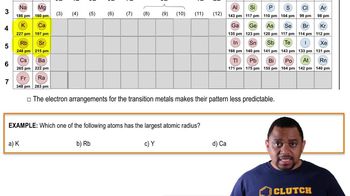
 01:07
01:07