Skip to main content
Introduction to Chemistry
My Course
Learn
Exam Prep
AI Tutor
Study Guides
Flashcards
Explore
Try the app
My Course
Learn
Exam Prep
AI Tutor
Study Guides
Flashcards
Explore
Try the app
Back
Law of Definite Proportions quiz
You can tap to flip the card.
Who originated the law of definite proportions and in what year?
You can tap to flip the card.
👆
Who originated the law of definite proportions and in what year?
Joseph L. Proust originated the law of definite proportions in 1799.
Track progress
Control buttons has been changed to "navigation" mode.
1/15
Related flashcards
Related practice
Recommended videos
Law of Definite Proportions definitions
Law of Definite Proportions
12 Terms
Law of Definite Proportions
5. Molecules and Compounds
4 problems
Topic
Periodic Table: Elemental Forms (Simplified)
5. Molecules and Compounds
5 problems
Topic
5. Molecules and Compounds
11 topics
32 problems
Chapter
Guided course
02:00
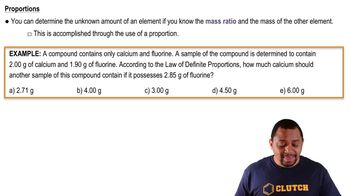
Law of Definite Proportions Example 1
6
views
1
rank
Guided course
02:26
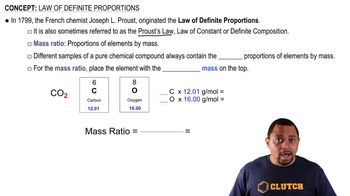
Law of Definite Proportions Example 2
8
views
1
rank
Guided course
02:48
Law of Definite Proportions
19
views
1
rank
Terms in this set (15)
Hide definitions
Who originated the law of definite proportions and in what year?
Joseph L. Proust originated the law of definite proportions in 1799.
What is another name for the law of definite proportions?
It is also called Proust's law or the law of constant composition.
What does the law of definite proportions state about chemical compounds?
It states that any chemical compound always contains the same proportions of its constituent elements by mass, regardless of the sample's source.
How are mass ratios used in the law of definite proportions?
Mass ratios are calculated by dividing the mass of one element in a compound by the mass of another element.
When calculating a mass ratio, which element's mass is placed on top?
The element with the larger mass contribution is placed on top.
What is the atomic mass of carbon used in the CO2 example?
The atomic mass of carbon used is 12.01 grams per mole.
What is the atomic mass of oxygen used in the CO2 example?
The atomic mass of oxygen used is 16 grams per mole.
How many oxygen atoms are in a molecule of CO2?
There are two oxygen atoms in a molecule of CO2.
What is the total mass of oxygen in one mole of CO2?
The total mass of oxygen in one mole of CO2 is 32 grams.
What is the total mass of carbon in one mole of CO2?
The total mass of carbon in one mole of CO2 is 12.01 grams.
What is the mass ratio of oxygen to carbon in CO2?
The mass ratio of oxygen to carbon in CO2 is approximately 2.66.
What does a mass ratio of 2.66 in CO2 indicate?
It indicates there are about 2.66 grams of oxygen for every gram of carbon in CO2.
How can the law of definite proportions be used to verify if two samples are the same compound?
If two samples have the same mass ratio of elements, they are the same compound according to the law.
What would you expect if you analyzed CO2 samples from New York City and London?
You would expect both samples to have the same mass ratio of oxygen to carbon if they are both CO2.
Why is the law of definite proportions important in chemistry?
It helps confirm the identity of compounds by ensuring their elemental composition by mass is constant.
 BackBack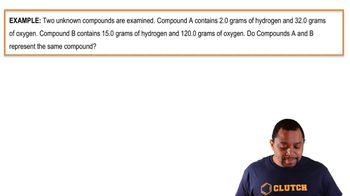
 02:00
02:00