Skip to main content
Introduction to Chemistry
My Course
Learn
Exam Prep
AI Tutor
Study Guides
Flashcards
Explore
Try the app
My Course
Learn
Exam Prep
AI Tutor
Study Guides
Flashcards
Explore
Try the app
Back
Law of Definite Proportions definitions
You can tap to flip the card.
Law of Definite Proportions
You can tap to flip the card.
👆
Law of Definite Proportions
A principle stating that a pure compound always contains the same elements in the same mass ratio, regardless of sample origin.
Track progress
Control buttons has been changed to "navigation" mode.
1/12
Related flashcards
Related practice
Recommended videos
Law of Definite Proportions quiz
Law of Definite Proportions
15 Terms
Law of Definite Proportions
5. Molecules and Compounds
4 problems
Topic
Periodic Table: Elemental Forms (Simplified)
5. Molecules and Compounds
5 problems
Topic
5. Molecules and Compounds
11 topics
32 problems
Chapter
Guided course
02:00
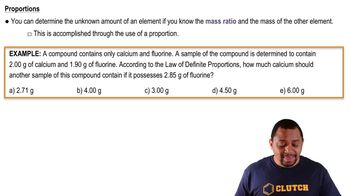
Law of Definite Proportions Example 1
6
views
1
rank
Guided course
02:26
Law of Definite Proportions Example 2
8
views
1
rank
Guided course
02:48
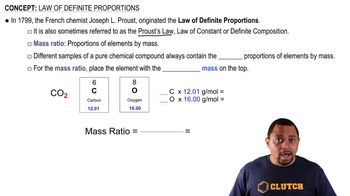
Law of Definite Proportions
19
views
1
rank
Terms in this set (12)
Hide definitions
Law of Definite Proportions
A principle stating that a pure compound always contains the same elements in the same mass ratio, regardless of sample origin.
Proust's Law
An alternative name for the rule that chemical compounds have constant elemental mass proportions, named after its originator.
Law of Constant Composition
A synonym for the concept that the elemental makeup by mass in a compound is unchanging across all samples.
Mass Ratio
A numerical value found by dividing the mass of one element in a compound by the mass of another, indicating their relative amounts.
Chemical Compound
A pure substance formed from two or more elements combined in fixed mass proportions.
Constituent Element
A basic substance that makes up a compound, contributing a specific mass to the whole.
Atomic Mass
A value representing the mass of a single atom, typically measured in grams per mole, used to calculate compound composition.
CO2
A molecule consisting of one carbon atom and two oxygen atoms, used as an example to illustrate fixed mass ratios.
Sample Origin
The geographic or physical source from which a compound is obtained, shown to not affect mass proportions.
Verification pipeline
A process involving comparison of mass ratios from different samples to confirm compound identity.
Periodic Table
A chart listing elements and their atomic masses, essential for calculating the mass contributions in compounds.
Pure Substance
A material with a uniform and definite composition, such as a compound with unchanging mass ratios.
 BackBack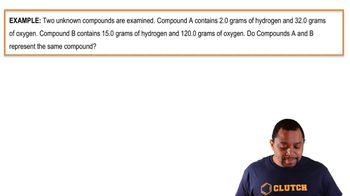
 02:00
02:00