Skip to main content
Introduction to Chemistry
My Course
Learn
Exam Prep
AI Tutor
Study Guides
Flashcards
Explore
Try the app
My Course
Learn
Exam Prep
AI Tutor
Study Guides
Flashcards
Explore
Try the app
Back
Law of Conservation of Mass quiz
You can tap to flip the card.
Who is credited with originating the law of conservation of mass?
You can tap to flip the card.
👆
Who is credited with originating the law of conservation of mass?
Antoine Levasseur, a French chemist, is credited with originating the law in 1789.
Track progress
Control buttons has been changed to "navigation" mode.
1/15
Related flashcards
Related practice
Recommended videos
Law of Conservation of Mass definitions
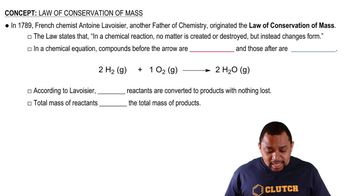
Law of Conservation of Mass
12 Terms
Law of Conservation of Mass
3. Matter and Energy
2 problems
Topic
Nature of Energy
3. Matter and Energy
5 problems
Topic
3. Matter and Energy - Part 1 of 2
12 topics
34 problems
Chapter
3. Matter and Energy - Part 2 of 2
1 topic
3 problems
Chapter
Guided course
01:20
Law of Conservation of Mass Example 1
9
views
1
rank
Guided course
01:48
Law of Conservation of Mass
17
views
Terms in this set (15)
Hide definitions
Who is credited with originating the law of conservation of mass?
Antoine Levasseur, a French chemist, is credited with originating the law in 1789.
What does the law of conservation of mass state about matter in a chemical reaction?
It states that matter is neither created nor destroyed in a chemical reaction, but only changes form.
What are reactants in a chemical reaction?
Reactants are the substances present before a chemical reaction occurs.
What are products in a chemical reaction?
Products are the substances formed as a result of a chemical reaction.
In the reaction H2 + O2 → H2O, what are the reactants?
The reactants are hydrogen (H2) and oxygen (O2).
In the reaction H2 + O2 → H2O, what is the product?
The product is water (H2O).
If the total mass of reactants is 100 grams, what will be the total mass of products after the reaction?
The total mass of products will also be 100 grams.
Does the law of conservation of mass allow for any loss of matter during a chemical reaction?
No, all matter is accounted for; it is only transformed, not lost.
How does the law of conservation of mass help in chemistry calculations?
It allows us to determine the amount of product that can be formed from a given amount of reactants.
Why is the law of conservation of mass fundamental to stoichiometry?
Because stoichiometry relies on the fact that the mass of reactants equals the mass of products.
What year did Antoine Levasseur originate the law of conservation of mass?
He originated the law in 1789.
What happens to the mass of reactants during a chemical reaction according to the law?
The mass of reactants is completely converted into the mass of products.
How does the law of conservation of mass relate to solution chemistry?
It ensures that the total mass remains constant, which is important for calculations in solution chemistry.
What does the law of conservation of mass imply about the atoms in a chemical reaction?
It implies that all atoms present in the reactants are rearranged to form the products, with none lost.
What is the significance of knowing the total mass of reactants before a reaction?
Knowing the total mass of reactants allows you to predict the total mass of products formed.
 BackBack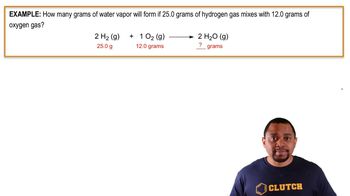
 01:20
01:20