Skip to main content
Introduction to Chemistry
My Course
Learn
Exam Prep
AI Tutor
Study Guides
Flashcards
Explore
Try the app
My Course
Learn
Exam Prep
AI Tutor
Study Guides
Flashcards
Explore
Try the app
Back
Law of Conservation of Mass definitions
You can tap to flip the card.
Law of Conservation of Mass
You can tap to flip the card.
👆
Law of Conservation of Mass
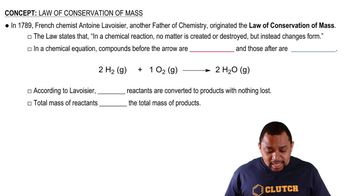
Principle stating that during a chemical reaction, the total amount of matter remains unchanged, only altering its form.
Track progress
Control buttons has been changed to "navigation" mode.
1/12
Related flashcards
Related practice
Recommended videos
Law of Conservation of Mass quiz
Law of Conservation of Mass
15 Terms
Law of Conservation of Mass
3. Matter and Energy
2 problems
Topic
Nature of Energy
3. Matter and Energy
5 problems
Topic
3. Matter and Energy - Part 1 of 2
12 topics
34 problems
Chapter
3. Matter and Energy - Part 2 of 2
1 topic
3 problems
Chapter
Guided course
01:20
Law of Conservation of Mass Example 1
9
views
1
rank
Guided course
01:48
Law of Conservation of Mass
17
views
Terms in this set (12)
Hide definitions
Law of Conservation of Mass
Principle stating that during a chemical reaction, the total amount of matter remains unchanged, only altering its form.
Antoine Lavoisier
French chemist recognized for formulating the foundational principle that matter is neither created nor destroyed in reactions.
Chemical Reaction
Process where substances interact to form new substances, with total mass remaining constant throughout.
Reactant
Substance present before a chemical change, participating in the transformation to form new materials.
Product
Substance resulting from a chemical transformation, formed from the rearrangement of initial materials.
Stoichiometry
Area of chemistry focused on calculating the quantities of substances involved in chemical changes.
Solution Chemistry
Branch of chemistry dealing with substances dissolved in liquids and their quantitative relationships.
Hydrogen
Lightest element, often involved as a reactant in reactions forming water, symbolized as H2.
Oxygen
Element essential for combustion and respiration, commonly reacts with hydrogen to produce water, symbolized as O2.
Water
Compound formed from hydrogen and oxygen, represented as H2O, often the product in chemical reactions.
Mass
Measure of the amount of matter in a substance, remaining unchanged before and after chemical changes.
Compound
Substance composed of two or more elements chemically bonded, participating in chemical transformations.
 BackBack
 01:20
01:20