Skip to main content
Introduction to Chemistry
My Course
Learn
Exam Prep
AI Tutor
Study Guides
Flashcards
Explore
Try the app
My Course
Learn
Exam Prep
AI Tutor
Study Guides
Flashcards
Explore
Try the app
Back
Heating and Cooling Curves quiz
You can tap to flip the card.
At what temperature does water melt or freeze on a heating or cooling curve?
You can tap to flip the card.
👆
At what temperature does water melt or freeze on a heating or cooling curve?
Water melts or freezes at 0 degrees Celsius.
Track progress
Control buttons has been changed to "navigation" mode.
1/15
Related flashcards
Related practice
Recommended videos
Heating and Cooling Curves definitions
Heating and Cooling Curves
15 Terms
Heating and Cooling Curves
12. Liquids, Solids, and Intermolecular Forces
5 problems
Topic
Atomic, Ionic and Molecular Solids
12. Liquids, Solids, and Intermolecular Forces
5 problems
Topic
12. Liquids, Solids, and Intermolecular Forces
4 topics
12 problems
Chapter
Guided course
05:54
The Cooling Curve
5
views
Guided course
09:10
Heating and Cooling Curves
4
views
Guided course
09:03
The Heating Curve
5
views
1
rank
Terms in this set (15)
Hide definitions
At what temperature does water melt or freeze on a heating or cooling curve?
Water melts or freezes at 0 degrees Celsius.
What is the temperature at which water boils or condenses?
Water boils or condenses at 100 degrees Celsius.
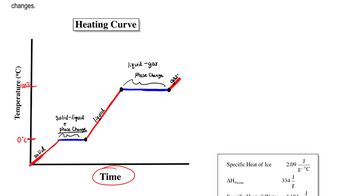
During a phase change on a heating curve, what happens to the temperature?
The temperature remains constant during a phase change.
What type of energy increases during a temperature change (not a phase change) on a heating curve?
Kinetic energy increases during a temperature change.
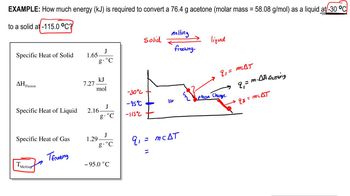
What equation is used to calculate heat during a temperature change?
The equation q = mcΔT is used, where m is mass, c is specific heat, and ΔT is the temperature change.
What equation is used to calculate heat during a phase change?
The equation q = mΔH is used, where ΔH is the enthalpy change for the phase transition.
How does the length of the phase change segment from liquid to gas compare to solid to liquid on a heating curve?
The liquid to gas segment is longer because it requires more energy to separate molecules further apart.
What happens to the average kinetic energy during a phase change?
The average kinetic energy remains constant during a phase change.
What is the sign of q (heat) during a heating curve and what does it indicate?
q is positive, indicating an endothermic process where heat is absorbed.
What is the sign of q (heat) during a cooling curve and what does it indicate?
q is negative, indicating an exothermic process where heat is released.
What is another name for the melting process?
Melting is also called fusion.
How are ΔH of vaporization and ΔH of condensation related?
They are equal in magnitude but opposite in sign; vaporization is positive (endothermic), condensation is negative (exothermic).
What happens to potential energy during a phase change?
Potential energy increases during melting or vaporization and decreases during freezing or condensation.
What is the physical state of water below 0 degrees Celsius?
Water exists as a solid (ice) below 0 degrees Celsius.
What determines whether you use grams or moles for mass in the heat equations?
You use grams if ΔH is given per gram, and moles if ΔH is given per mole.
 BackBack
 05:54
05:54