Skip to main content
Introduction to Chemistry
My Course
Learn
Exam Prep
AI Tutor
Study Guides
Flashcards
Explore
Try the app
My Course
Learn
Exam Prep
AI Tutor
Study Guides
Flashcards
Explore
Try the app
Back
Chemistry Gas Laws: Combined Gas Law quiz
You can tap to flip the card.
What three individual gas laws are combined to form the combined gas law?
You can tap to flip the card.
👆
What three individual gas laws are combined to form the combined gas law?
Boyle's law, Charles' law, and Gay Lussac's law are combined to form the combined gas law.
Track progress
Control buttons has been changed to "navigation" mode.
1/15
Related flashcards
Related practice
Recommended videos
Chemistry Gas Laws: Combined Gas Law definitions
Chemistry Gas Laws: Combined Gas Law
14 Terms
Chemistry Gas Laws: Combined Gas Law
11 Gases
5 problems
Topic
Standard Temperature and Pressure
11 Gases
5 problems
Topic
11 Gases
10 topics
26 problems
Chapter
Guided course
03:35
Chemistry Gas Laws: Combined Gas Law Example 1
6
views
Guided course
01:43
Chemistry Gas Laws: Combined Gas Law
14
views
1
rank
Terms in this set (15)
Hide definitions
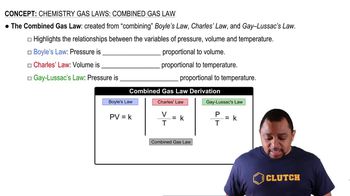
What three individual gas laws are combined to form the combined gas law?
Boyle's law, Charles' law, and Gay Lussac's law are combined to form the combined gas law.
What variables does the combined gas law relate?
The combined gas law relates pressure, volume, and temperature.
According to Boyle's law, how are pressure and volume related?
Pressure is inversely proportional to volume according to Boyle's law.
What does Charles' law state about the relationship between volume and temperature?
Charles' law states that volume is directly proportional to temperature.
How does Gay Lussac's law relate pressure and temperature?
Gay Lussac's law states that pressure is directly proportional to temperature.
What is the mathematical expression for the combined gas law?
The combined gas law is expressed as PV/T = k, where k is a constant.
How is the combined gas law written when comparing two sets of conditions?
It is written as P1V1/T1 = P2V2/T2.
In the combined gas law equation, what does the constant k represent?
The constant k represents a constant value for a given amount of gas.
If the temperature increases while pressure is constant, what happens to the volume according to the combined gas law?
The volume increases as temperature increases if pressure is constant.
If the volume decreases and temperature remains constant, what happens to the pressure?
The pressure increases as volume decreases if temperature is constant.
What must remain constant for the combined gas law to apply?
The amount of gas (number of moles) must remain constant.
How can you derive the combined gas law from the individual gas laws?
By combining the relationships from Boyle's, Charles', and Gay Lussac's laws, you derive PV/T = k.
What happens to the value of PV/T for a fixed amount of gas?
PV/T remains constant for a fixed amount of gas.
Why is temperature always in the denominator in the combined gas law equation?
Temperature is in the denominator because both Charles' and Gay Lussac's laws relate variables to temperature in the denominator.
What units must temperature be in when using the combined gas law?
Temperature must be in Kelvin when using the combined gas law.
 BackBack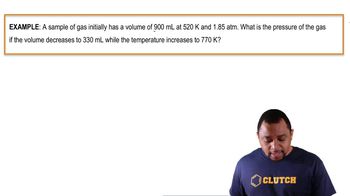
 03:35
03:35