Skip to main content
Introduction to Chemistry
My Course
Learn
Exam Prep
AI Tutor
Study Guides
Flashcards
Explore
Try the app
My Course
Learn
Exam Prep
AI Tutor
Study Guides
Flashcards
Explore
Try the app
Back
Chemistry Gas Laws: Combined Gas Law definitions
You can tap to flip the card.
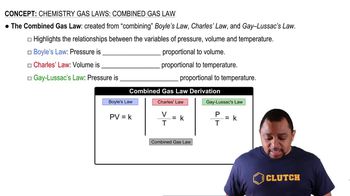
Combined Gas Law
You can tap to flip the card.
👆
Combined Gas Law
An equation relating pressure, volume, and temperature for a fixed amount of gas, integrating three foundational gas laws.
Track progress
Control buttons has been changed to "navigation" mode.
1/14
Related flashcards
Related practice
Recommended videos
Chemistry Gas Laws: Combined Gas Law quiz
Chemistry Gas Laws: Combined Gas Law
15 Terms
Chemistry Gas Laws: Combined Gas Law
11 Gases
5 problems
Topic
Standard Temperature and Pressure
11 Gases
5 problems
Topic
11 Gases
10 topics
30 problems
Chapter
Guided course
03:35
Chemistry Gas Laws: Combined Gas Law Example 1
5
views
Guided course
01:43
Chemistry Gas Laws: Combined Gas Law
14
views
1
rank
Terms in this set (14)
Hide definitions
Combined Gas Law
An equation relating pressure, volume, and temperature for a fixed amount of gas, integrating three foundational gas laws.
Boyle's Law
A principle stating that pressure and volume of a gas are inversely proportional when temperature is constant.
Charles' Law
A principle stating that volume and temperature of a gas are directly proportional when pressure is constant.
Gay Lussac's Law
A principle stating that pressure and temperature of a gas are directly proportional when volume is constant.
Pressure
A variable representing the force exerted by gas particles per unit area on the walls of a container.
Volume
A variable representing the amount of space occupied by a gas within a container.
Temperature
A variable reflecting the average kinetic energy of gas particles, affecting both pressure and volume.
Proportionality
A mathematical relationship where one variable changes in response to another, either directly or inversely.
Constant
A fixed value representing the ratio of pressure and volume to temperature for a given amount of gas.
Numerator
The part of a fraction found above the line, representing pressure and volume in the combined gas law equation.
Denominator
The part of a fraction found below the line, representing temperature in the combined gas law equation.
Equation
A mathematical statement showing the equality of two expressions, such as PV/T = k in gas law calculations.
Variable
A symbol representing a quantity that can change, such as pressure, volume, or temperature in gas law equations.
Set of Conditions
A specific combination of pressure, volume, and temperature values used to compare different states of a gas.
 BackBack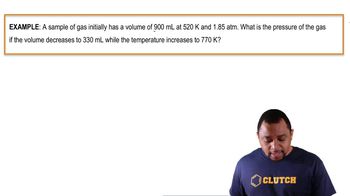
 03:35
03:35