What is the main idea behind the Bronsted-Lowry definition of acids?
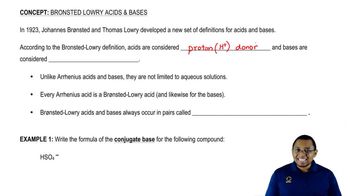
Bronsted-Lowry defines acids as proton (H+) donors. This means acids give away an H+ ion.
How does the Bronsted-Lowry definition of bases differ from the Arrhenius definition?
Bronsted-Lowry defines bases as proton (H+) acceptors, not requiring OH-. Arrhenius defines bases as substances that produce OH- in water.
What is a proton in the context of Bronsted-Lowry theory?
A proton refers to an H+ ion. It is the particle donated or accepted in acid-base reactions.
Can Bronsted-Lowry acids and bases exist in non-aqueous solutions?
Yes, Bronsted-Lowry theory applies to solutions beyond just water. Arrhenius theory is limited to aqueous solutions.
What is a conjugate acid-base pair?
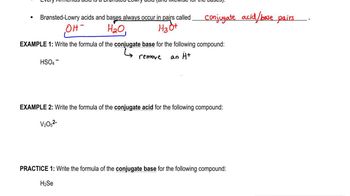
A conjugate acid-base pair consists of two species that differ by only one hydrogen ion (H+). One is the acid, and the other is its conjugate base.
How do H2O and OH- form a conjugate acid-base pair?
H2O and OH- differ by one H+ ion. H2O is the acid, and OH- is its conjugate base.
What is the relationship between H3O+ and H2O in Bronsted-Lowry theory?
H3O+ and H2O are a conjugate acid-base pair. H3O+ is the acid, and H2O is its conjugate base.
Why does a base accept H+ according to Bronsted-Lowry?
A base accepts H+ because it has lone pairs or a negative charge. These features attract the positive H+ ion.
Do Arrhenius acids and Bronsted-Lowry acids always agree?
Yes, Arrhenius acids are also Bronsted-Lowry acids. Both definitions agree that acids donate or increase H+.
What is the key disagreement between Arrhenius and Bronsted-Lowry regarding bases?
Arrhenius requires bases to produce OH- in water, while Bronsted-Lowry only requires bases to accept H+.
What is required for a substance to be a Bronsted-Lowry base?
It must be able to accept a proton (H+). This usually means it has lone pairs or a negative charge.
What does it mean for conjugate acid-base pairs to differ by one hydrogen?
It means one member of the pair has one more H+ than the other. The acid has the extra H+, the base has one less.
Why are Bronsted-Lowry acids and bases considered more general than Arrhenius acids and bases?
Bronsted-Lowry theory applies to all solutions, not just water. Arrhenius is limited to aqueous solutions.
What is the significance of lone pairs in Bronsted-Lowry bases?
Lone pairs allow bases to accept H+ ions. This is essential for their role as proton acceptors.
How did Bronsted-Lowry improve the definition of acids and bases?
They expanded the definition to include proton donors and acceptors, not just substances that produce H+ or OH- in water. This made the theory applicable to more types of reactions.
 Back
Back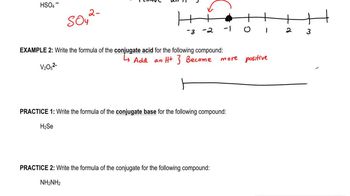
 01:00
01:00