Skip to main content
Introduction to Chemistry
My Course
Learn
Exam Prep
AI Tutor
Study Guides
Flashcards
Explore
Try the app
My Course
Learn
Exam Prep
AI Tutor
Study Guides
Flashcards
Explore
Try the app
Back
Bronsted Lowry Acid and Base definitions
You can tap to flip the card.
Bronsted-Lowry Theory
You can tap to flip the card.
👆
Bronsted-Lowry Theory
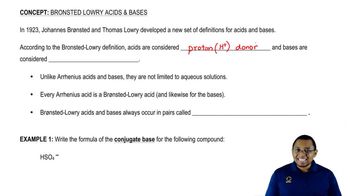
A model describing acids as proton donors and bases as proton acceptors, applicable beyond just water-based solutions.
Track progress
Control buttons has been changed to "navigation" mode.
1/12
Related flashcards
Related practice
Recommended videos
Bronsted Lowry Acid and Base quiz
Bronsted Lowry Acid and Base
15 Terms
Bronsted Lowry Acid and Base
14. Acids and Bases
5 problems
Topic
Acid and Base Strength
14. Acids and Bases
5 problems
Topic
14. Acids and Bases
10 topics
30 problems
Chapter
Guided course
01:00
Bronsted Lowry Acids & Bases Example 2
7
views
Guided course
03:17
Bronsted Lowry Acids & Bases Concept 1
9
views
Guided course
01:23
Bronsted Lowry Acids & Bases Example 1
7
views
Terms in this set (12)
Hide definitions
Bronsted-Lowry Theory
A model describing acids as proton donors and bases as proton acceptors, applicable beyond just water-based solutions.
Arrhenius Definition
A model where acids increase H+ concentration in water and bases produce OH-, limited to aqueous solutions.
Proton
A hydrogen ion (H+) that can be donated by acids or accepted by bases in chemical reactions.
Acid
A substance capable of donating a hydrogen ion (H+) to another species in a chemical reaction.
Base
A substance capable of accepting a hydrogen ion (H+) from another species, often possessing lone pairs or negative charge.
Conjugate Acid-Base Pair
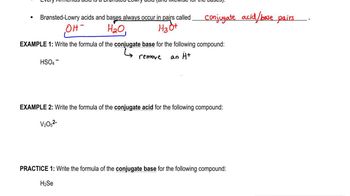
Two species differing by only one hydrogen ion (H+), related through the gain or loss of a proton.
Hydronium Ion
A water molecule with an extra hydrogen ion, represented as H3O+, formed when acids donate H+ in water.
Hydroxide Ion
A negatively charged ion (OH-) formed when a base accepts a hydrogen ion or when water loses H+.
Lone Pair
A pair of valence electrons not involved in bonding, often responsible for a base's ability to accept H+.
Aqueous Solution
A mixture where water is the solvent, central to Arrhenius but not required for Bronsted-Lowry definitions.
Negative Charge
An excess of electrons on a species, increasing its tendency to attract and accept a hydrogen ion.
Hydrogen Ion
A single proton (H+) released by acids or accepted by bases, central to acid-base reactions.
 BackBack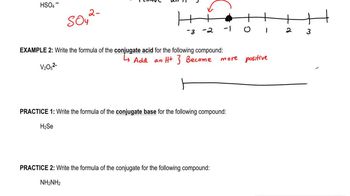
 01:00
01:00