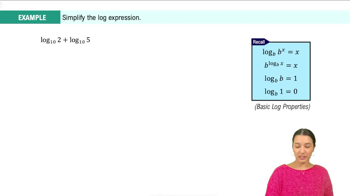
What does the product property of logarithms state?
The product property states that log_b(mn) = log_b(m) + log_b(n), turning multiplication inside the argument into addition of logs.
How can you use the product property to expand log_5(3x)?
You can expand log_5(3x) as log_5(3) + log_5(x) using the product property.
When condensing logs using the product property, what must be true about the logs?
The logs must have the same base in order to condense them into a single log using the product property.
Is log_b(m + n) equal to log_b(m) + log_b(n)? Why or why not?
No, log_b(m + n) is not equal to log_b(m) + log_b(n); the product property only applies to multiplication, not addition, inside the argument.
What does the quotient property of logarithms state?
The quotient property states that log_b(m/n) = log_b(m) - log_b(n), turning division inside the argument into subtraction of logs.
How would you expand log_10(7/x) using the quotient property?
You would expand log_10(7/x) as log_10(7) - log_10(x).
How do you condense log_5(32) - log_5(8) into a single log?
You condense it as log_5(32/8), which simplifies to log_5(4).
Can you apply the quotient property to log_b(m - n)? Why or why not?
No, the quotient property only applies to division in the argument, not subtraction; log_b(m - n) cannot be simplified using log properties.
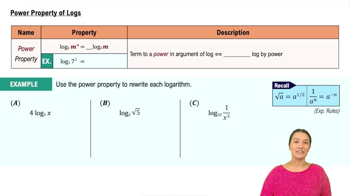
What does the power property of logarithms state?
The power property states that log_b(m^n) = n * log_b(m), allowing exponents in the argument to be moved in front as coefficients.
How would you rewrite 4 * log_5(x) using the power property?
You would rewrite it as log_5(x^4) by moving the coefficient into the exponent.
How can you use the power property to expand log_2(√5)?
Since √5 = 5^(1/2), you can expand log_2(√5) as (1/2) * log_2(5).
How do you use the power property to rewrite log_10(1/x^3)?
Rewrite 1/x^3 as x^(-3), then use the power property to get -3 * log_10(x).
When expanding log_10(3xy^2), what properties and steps do you use?
First, use the product property to get log_10(3) + log_10(x) + log_10(y^2), then use the power property to rewrite log_10(y^2) as 2 * log_10(y).
When condensing 4 * log_5(x) - log_5(x + 2), which property should you apply first?
Apply the power property first to get log_5(x^4) - log_5(x + 2), then use the quotient property to condense to log_5(x^4 / (x + 2)).
Why is it important to apply the power property before the product or quotient property when condensing logs?
Applying the power property first ensures that all coefficients are moved into exponents, making it possible to correctly combine logs using the product or quotient properties.
 Back
Back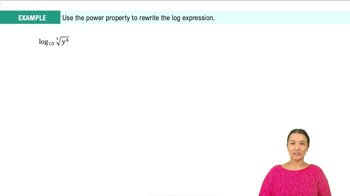
 00:48
00:48