Represents the exponent needed for a base to produce a given number; connects multiplication, division, and powers to addition, subtraction, and multiplication.
Base
The fixed number in a logarithmic expression that is raised to a power to yield the argument.
Argument
The value inside a logarithmic function, representing the number for which the logarithm is calculated.
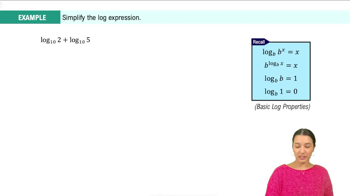
Product Property
Allows rewriting a log of a product as the sum of logs with the same base, turning multiplication inside into addition outside.
Quotient Property
Allows rewriting a log of a quotient as the difference of logs with the same base, turning division inside into subtraction outside.
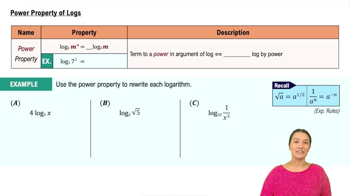
Power Property
Allows moving an exponent in the argument to the front as a coefficient, or vice versa, connecting powers and multiplication.
Expansion
The process of rewriting a single logarithm as a sum, difference, or multiple of several logarithms using log properties.
Condensation
The process of combining multiple logarithmic terms into a single logarithm by applying log properties in reverse.
Exponent
Indicates how many times the base is multiplied by itself; can be moved in or out of a logarithm using the power property.
Coefficient
A number multiplying a logarithm, which can be moved into the argument as an exponent using the power property.
Sum
The result of adding two or more logarithms, often produced by expanding a log of a product.
Difference
The result of subtracting one logarithm from another, often produced by expanding a log of a quotient.
Same Base
A requirement for combining or condensing logarithms using product or quotient properties; all logs involved must share this feature.
Multiplication
An operation inside a logarithm that, when present, allows use of the product property to expand into a sum of logs.
Division
An operation inside a logarithm that, when present, allows use of the quotient property to expand into a difference of logs.
Addition
An operation inside a logarithm that cannot be simplified using log properties; does not correspond to a log property.
Subtraction
An operation inside a logarithm that cannot be simplified using log properties; does not correspond to a log property.
Root
A radical expression in the argument, which can be rewritten as a fractional exponent to apply the power property.
Fractional Exponent
An exponent expressed as a fraction, often used to represent roots within logarithmic arguments.
Negative Exponent
An exponent less than zero, indicating reciprocal values; useful for rewriting fractions in logarithmic arguments.
Single Logarithm
A logarithmic expression not split into a sum or difference; often the result of condensing multiple logs.
Multiple Logarithms
A sum or difference of two or more logarithmic terms, often produced by expanding a single log.
Simplification
The process of rewriting logarithmic expressions in a more compact or expanded form using log properties.
 Back
Back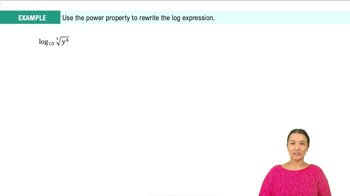
 00:48
00:48