What is the defining characteristic of a geometric sequence?
A geometric sequence is defined by a constant multiplier, called the common ratio, between consecutive terms.
How do you find the common ratio (r) in a geometric sequence?
Divide any term in the sequence by its previous term to find the common ratio.
What is the general formula for the nth term of a geometric sequence?
The nth term is given by an = a1 * r^(n-1), where a1 is the first term and r is the common ratio.
How do you distinguish between an arithmetic and a geometric sequence?
An arithmetic sequence adds a constant value (common difference), while a geometric sequence multiplies by a constant value (common ratio).
If the first term of a geometric sequence is 5 and the second term is 20, what is the common ratio?
The common ratio is 20 divided by 5, which equals 4.
Given a geometric sequence with a1 = 3 and r = 2, what is the formula for the nth term?
The formula is an = 3 * 2^(n-1).
How do you find the next term in a geometric sequence if you know the current term and the common ratio?
Multiply the current term by the common ratio to get the next term.
What is the common ratio in the sequence 9, 3, 1, 1/3?
The common ratio is 1/3, since each term is obtained by multiplying the previous term by 1/3.
How can dividing by a number in a sequence be interpreted in terms of the common ratio?
Dividing by a number is the same as multiplying by its reciprocal, which becomes the common ratio.
If a geometric sequence starts with 8 and has a common ratio of 3, what is the nth term formula?
The nth term formula is an = 8 * 3^(n-1).
How do you express the first term of a geometric sequence using the general formula?
The first term is a1 = a1 * r^0, since r^0 equals 1.
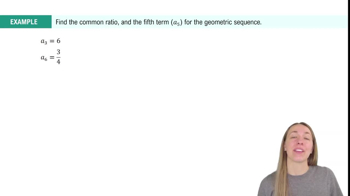
In the sequence 16/27, 8/9, 3/4, 2, how do you find the common ratio?
Divide 8/9 by 16/27, which simplifies to 3/2.
What is the nth term formula for the sequence 16/27, 8/9, 3/4, 2?
The formula is an = (16/27) * (3/2)^(n-1).
Why is the exponent in the general term formula (n-1) instead of n?
Because the first term is multiplied by the common ratio zero times, the second term once, and so on, so the exponent is always one less than the term number.
How can you efficiently find the 20th term of a geometric sequence without listing all previous terms?
Use the general formula an = a1 * r^(n-1) and substitute n = 20 to calculate the term directly.
 Back
Back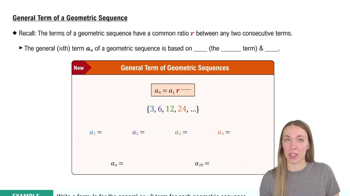
 06:04
06:04