Skip to main content
Intermediate Algebra
My Course
Learn
AI Tutor
Study Guides
Flashcards
Explore
Try the app
My Course
Learn
AI Tutor
Study Guides
Flashcards
Explore
Try the app
Back
Geometric Sequences definitions
You can tap to flip the card.
Geometric Sequence
You can tap to flip the card.
👆
Geometric Sequence
A list of numbers where each term is found by multiplying the previous term by a fixed value called the common ratio.
Track progress
Control buttons has been changed to "navigation" mode.
1/25
Related flashcards
Recommended videos
Geometric Sequences quiz
Geometric Sequences
15 Terms
06:04
General Term of a Geometric Sequence
2
views
02:22
General Term of a Geometric Sequence Example 1
2
views
02:11
General Term of a Geometric Sequence Example 2
2
views
Terms in this set (25)
Hide definitions
Geometric Sequence
A list of numbers where each term is found by multiplying the previous term by a fixed value called the common ratio.
Arithmetic Sequence
A list of numbers where each term is found by adding a fixed value, known as the common difference, to the previous term.
Common Ratio
A constant multiplier used to move from one term to the next in a geometric sequence, found by dividing a term by its previous term.
Common Difference
A fixed value added to each term to get the next term in an arithmetic sequence.
General Term
A formula that allows calculation of any term in a sequence based on its position, without listing all previous terms.
First Term
The initial value in a sequence, often denoted as a₁, which serves as the starting point for generating subsequent terms.
Exponent
A mathematical notation indicating how many times a number, such as the common ratio, is multiplied by itself.
Sequence
An ordered list of numbers following a specific pattern or rule.
Term
An individual number or element in a sequence, identified by its position.
Position
The place or index of a term within a sequence, often represented by n.
Fraction
A numerical quantity that is not a whole number, often used in sequences with non-integer common ratios.
Power
The result of raising a number, such as the common ratio, to an exponent, indicating repeated multiplication.
Formula
A mathematical expression that provides a rule for calculating terms in a sequence.
aₙ
A symbol representing the nth term in a sequence, where n indicates the term's position.
a₁
A symbol representing the first term in a sequence, serving as the base for generating other terms.
n
A variable representing the position of a term in a sequence, used in general term formulas.
r
A symbol representing the common ratio in a geometric sequence.
n−1
An expression indicating one less than the term's position, used as the exponent in the general term formula for geometric sequences.
Exponential Expression
A mathematical statement involving a base raised to a power, such as r^(n−1) in geometric sequences.
Multiplication
The operation used to generate each new term in a geometric sequence by applying the common ratio.
Division
The operation used to find the common ratio by comparing consecutive terms in a geometric sequence.
General nth Term Formula
An equation, aₙ = a₁·r^(n−1), that calculates any term in a geometric sequence using the first term and common ratio.
Consecutive Terms
Two terms that appear one after the other in a sequence.
Pattern
A recognizable rule or relationship that defines how terms in a sequence are generated.
Series
The sum of the terms of a sequence, often studied after understanding sequences.
 BackBack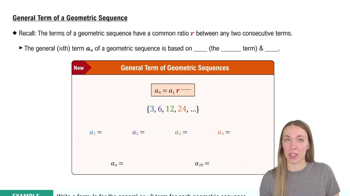
 06:04
06:04