Skip to main content
Intermediate Algebra
My Course
Learn
AI Tutor
Study Guides
Flashcards
Explore
Try the app
My Course
Learn
AI Tutor
Study Guides
Flashcards
Explore
Try the app
Back
Direct & Inverse Variation quiz
You can tap to flip the card.
What is the general equation for direct variation?
You can tap to flip the card.
👆
What is the general equation for direct variation?
The general equation for direct variation is y = kx, where k is the constant of variation.
Track progress
Control buttons has been changed to "navigation" mode.
1/15
Related flashcards
Recommended videos
Direct & Inverse Variation definitions
Direct & Inverse Variation
25 Terms
04:31
Direct Variation
3
views
04:33
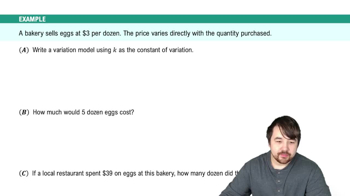
Direct Variation Example 1
2
views
05:33
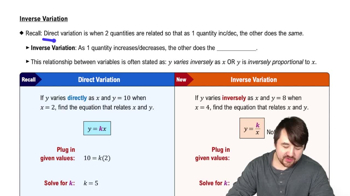
Inverse Variation
2
views
Terms in this set (15)
Hide definitions
What is the general equation for direct variation?
The general equation for direct variation is y = kx, where k is the constant of variation.
How do you describe the relationship between two variables in direct variation?
In direct variation, as one variable increases or decreases, the other does the same.
What does the constant of variation (k) represent in direct variation?
The constant of variation (k) is the fixed value that connects the two variables in the equation y = kx.
How do you find the constant of variation in a direct variation problem?
You substitute the given values of x and y into y = kx and solve for k.
What does it mean if y varies directly as x?
It means y is directly proportional to x, or y = kx for some constant k.
What is the general equation for inverse variation?
The general equation for inverse variation is y = k/x, where k is the constant of variation.
How do the variables in inverse variation relate to each other?
In inverse variation, as one variable increases, the other decreases, and vice versa.
How do you find the constant of variation in an inverse variation problem?
You substitute the given values of x and y into y = k/x and solve for k.
What does it mean if y varies inversely as x?
It means y is inversely proportional to x, or y = k/x for some constant k.
What restriction exists for the variable x in inverse variation?
x cannot be zero in inverse variation because division by zero is undefined.
If y = 10 when x = 2 in a direct variation, what is the equation relating x and y?
First, k = 10/2 = 5, so the equation is y = 5x.
If y = 8 when x = 4 in an inverse variation, what is the equation relating x and y?
First, k = 8 × 4 = 32, so the equation is y = 32/x.
How do you solve for y in a direct variation equation once you know k and x?
You multiply k by x, using the equation y = kx.
How do you solve for y in an inverse variation equation once you know k and x?
You divide k by x, using the equation y = k/x.
What are two phrases that indicate a direct variation relationship?
The phrases 'varies directly as' and 'is directly proportional to' both indicate direct variation.
 BackBack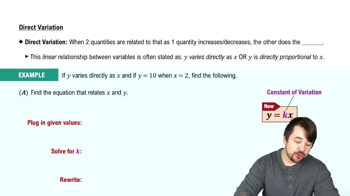
 04:31
04:31