Skip to main content
Intermediate Algebra
My Course
Learn
AI Tutor
Study Guides
Flashcards
Explore
Try the app
My Course
Learn
AI Tutor
Study Guides
Flashcards
Explore
Try the app
Back
Direct & Inverse Variation definitions
You can tap to flip the card.
Direct Variation
You can tap to flip the card.
👆
Direct Variation
A relationship where two quantities increase or decrease together, modeled by a linear equation with a constant multiplier.
Track progress
Control buttons has been changed to "navigation" mode.
1/25
Related flashcards
Recommended videos
Direct & Inverse Variation quiz
Direct & Inverse Variation
15 Terms
04:31
Direct Variation
3
views
04:33
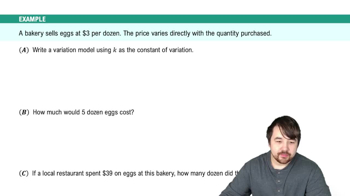
Direct Variation Example 1
2
views
05:33
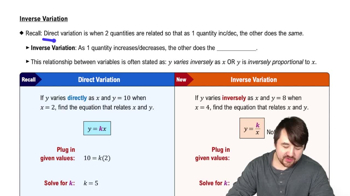
Inverse Variation
2
views
Terms in this set (25)
Hide definitions
Direct Variation
A relationship where two quantities increase or decrease together, modeled by a linear equation with a constant multiplier.
Inverse Variation
A relationship where one quantity increases as the other decreases, represented by a constant divided by a variable.
Constant of Variation
A fixed value that links two variables in a variation equation, found using a known pair of values.
Linear Relationship
A connection between variables that forms a straight line when graphed, such as in direct variation.
Proportionality
A consistent ratio or relationship between two quantities, either direct or inverse.
Equation of Direct Variation
An expression in the form y = kx, showing two variables changing together with a constant multiplier.
Equation of Inverse Variation
An expression in the form y = k/x, showing one variable changes as the reciprocal of the other.
Variable
A symbol representing a quantity that can change or take on different values in an equation.
Restriction
A limitation on variable values, such as excluding zero in inverse variation to avoid division by zero.
Direct Proportion
A situation where two quantities maintain a constant ratio, increasing or decreasing together.
Inverse Proportion
A situation where the product of two quantities remains constant as one increases and the other decreases.
Known Pair of Values
A specific set of variable values used to determine the constant in a variation equation.
Real World Application
A practical scenario where variation concepts are used to model relationships between measurable quantities.
Directly Proportional
A description for variables that change in the same direction at a constant rate.
Inversely Proportional
A description for variables that change in opposite directions, maintaining a constant product.
Linear Equation
An algebraic statement where variables are to the first power and graph as a straight line.
Reciprocal Relationship
A connection where one variable is the inverse of another, as seen in inverse variation.
Multiplicative Constant
A fixed number multiplied by a variable in direct variation equations.
Division by Zero
An undefined operation that must be avoided, especially in inverse variation equations.
Substitution
The process of replacing a variable with a specific value to solve for another quantity.
Graph of Direct Variation
A straight line through the origin, representing a direct relationship between variables.
Graph of Inverse Variation
A curve that approaches the axes but never touches them, showing an inverse relationship.
Opposite Relationship
A situation where one variable increases as the other decreases, characteristic of inverse variation.
Origin
The point (0,0) on a graph, which direct variation lines always pass through.
Product
The result of multiplying two quantities, which remains constant in inverse variation.
 BackBack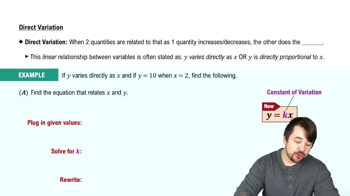
 04:31
04:31