Table of contents
- 1. Introduction to Biology
- 2. Chemistry of Life
- Atoms - Smallest Unit of Matter
- Isotopes
- Introduction to Chemical Bonding
- Covalent Bonds
- Noncovalent Bonds
- Ionic Bonding
- Hydrogen Bonding
- Introduction to Water
- Properties of Water - The Universal Solvent
- Properties of Water - Thermal
- Acids and Bases
- pH Scale
- Carbon
- Monomers & Polymers
- Carbohydrates
- Lipids
- Proteins
- Nucleic Acids
- ATP
- 3. Structure & Function of Cells
- Prokaryotic & Eukaryotic Cells
- Microscopes
- Introduction to Eukaryotic Organelles
- Endomembrane System: Protein Secretion
- Endomembrane System: Digestive Organelles
- Mitochondria & Chloroplasts
- Introduction to the Cytoskeleton
- Biological Membranes
- Concentration Gradients and Diffusion
- Introduction to Membrane Transport
- Osmosis
- Simple and Facilitated Diffusion
- Passive vs. Active Transport
- Active Transport
- Endocytosis & Exocytosis
- Introduction to Metabolism
- Introduction to Cellular Respiration
- Types of Phosphorylation
- Glycolysis
- Pyruvate Oxidation
- Krebs Cycle
- Electron Transport Chain
- 4. Tissues & Organ Systems
- Introduction to Tissues & Histology
- Introduction to Epithelial Tissue
- Characteristics of Epithelial Tissue
- Structural Naming of Epithelial Tissue
- Introduction to Connective Tissue
- Classes of Connective Tissue
- Introduction to Connective Tissue Proper
- Specialized Connective Tissue: Cartilage
- Specialized Connective Tissue: Bone
- Specialized Connective Tissue: Blood
- Introduction to Muscle Tissue
- Types of Muscle Tissue
- Introduction to Nervous Tissue
- Nervous Tissue: The Neuron
- Levels of Organization
- Introduction to Organ Systems
- Homeostasis
- Feedback Loops
- Feedback Loops: Negative Feedback
- Feedback Loops: Positive Feedback
- Introduction to the Integumentary System
- 5. The Skeletal System
- An Introduction to Bone and Skeletal Tissue
- Gross Anatomy of Bone: Compact and Spongy Bone
- Gross Anatomy of Bone: Periosteum and Endosteum
- Gross Anatomy of Bone: Bone Marrow
- Gross Anatomy of Bone: Short, Flat, and Irregular Bones
- Gross Anatomy of Bones - Structure of a Long Bone
- Microscopic Anatomy of Bones - Bone Matrix
- Introduction to the Skeleton
- The Skull
- The Spine
- The Thoracic Cage
- The Pectoral Girdle
- Bones of the Upper Limb
- The Pelvic Girdle
- Bone of the Lower Limb
- Introduction to Joints
- 6. The Muscular System
- 7. Blood
- 8. The Heart & Blood Vessels
- 9. The Immune & Lymphatic Systems
- Introduction to the Lymphatic System
- Lymphoid Cells & Tissues
- Overview of Lymphoid Organs
- Primary Lymphoid Organs
- Secondary Lymphoid Organs: Lymph Nodes
- Secondary Lymphoid Organs: The Spleen
- Introduction to Immunity
- Introduction to Innate Immunity
- Introduction to First-Line Defenses
- Physical Barriers in First-Line Defenses: Skin
- Physical Barriers in First-Line Defenses: Mucous Membrane
- First-Line Defenses: Chemical Barriers
- First-Line Defenses: Normal Microbiota
- Introduction to Cells of the Immune System
- Cells of the Immune System: Granulocytes
- Cells of the Immune System: Agranulocytes
- Introduction to the Complement System
- Antigens
- Introduction to T Lymphocytes
- Major Histocompatibility Complex Molecules
- Functions of T Lymphocytes
- Review of Cytotoxic vs. Helper T Cells
- Introduction to B LymphocytesBonus
- Antibodies
- Classes of Antibodies
- Primary & Secondary Response of Adaptive Immunity
- Types of Acquired Immunity
- Introduction to Vaccines
- Immunotherapy: Monoclonal Antibodies
- Introduction to Antimicrobial Drugs
- How Antimicrobial Drugs Work
- Antimicrobial Resistance
- Type I Hypersensitivities
- Autoimmune Diseases
- 10. The Respiratory System
- 11. The Nervous System & Nervous Tissue
- Ions - Sodium and Potassium
- Resting Membrane Potential
- Change in Membrane Potential
- Properties of Graded and Action Potentials
- Graded Potentials
- Action Potentials
- The Refractory Period
- Propagation of Action Potentials
- Introduction to the Central Nervous System
- The Cerebrum
- Introduction to the Autonomic Nervous System
- Control of the ANS
- Introduction to Reflex Arcs
- Reflex Arcs
- Sympathetic Nervous System
- Parasympathetic Nervous System
- Review of the Sympathetic and Parasympathetic Divisions
- 12. Sensory Mechanisms
- 13. The Endocrine System
- 14. The Digestive System and Nutrition
- Overview of the Digestive System
- Organs of the Gastrointenstinal Tract
- Accessory Organs
- Nutrient Absorption and Transport
- Introduction to Nutrition
- Dietary Guidelines for Americans
- Macronutrients
- Micronutrients
- Fiber and Phytochemicals
- Food Labels
- Energy in Food
- Healthy Weight
- Energy Balance
- Eating Disorders
- Disorders of the Digestive System
- 15. The Urinary System
- 16. The Reproductive System
- 17. Cell Reproduction & Differentiation
- Introduction to Cell Division
- Organization of DNA in the Cell
- Introduction to the Cell Cycle
- Genes & Alleles
- Central Dogma
- Introduction to Transcription
- Steps of Transcription
- Introduction to Types of RNA
- Genetic Code
- Introduction to Translation
- Steps of Translation
- Phases of Mitosis
- Introduction to Meiosis
- Meiosis I
- Meiosis II
- Cell Cycle Regulation
- 18. Cancer
- 19. Genetics & Inheritance
- 20. Genetic Engineering
- 21. Development, Maturation & Aging
- 22. Evolution and the Origins of Life
- 23. Ecology
- 24. Human Environmental Impact
7. Blood
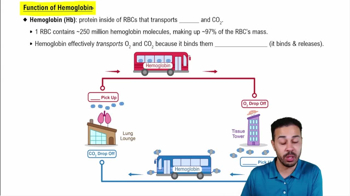
Erythrocytes: Hemoglobin
7. Blood
Erythrocytes: Hemoglobin
 7:52
7:52

Practice this topic
- Multiple Choice
Why is it important for erythrocytes to have a high surface area to volume ratio?
5views - Multiple Choice
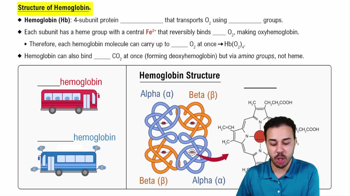
How many heme groups are required to synthesize 4 hemoglobin molecules?
4views - Multiple Choice
Cynthia lives in Miami, a city at low altitude. She goes on a month-long trip to the Andes Mountain range (at high altitude) where the air pressure is lower and therefore there is less oxygen in each breath she takes. Upon returning to Miami, how might a sample of her blood differ from a sample taken before she left for her trip?
3views - Multiple Choice
Anemia is a blood disorder where the O2- carrying capacity of blood is too low to support the body's tissues. Which of the following is not a possible cause of anemia?
7views