
Textbook Question
Each of these reactions is involved in one of the four stages of metabolism shown in Figure 21.4. Identify the stage in which each reaction occurs.
<IMAGE>
b. Oxidation of NADH coupled with synthesis of ATP
1
views
 Verified step by step guidance
 1:39
1:39
 2:31 2:31
Each of these reactions is involved in one of the four stages of metabolism shown in Figure 21.4. Identify the stage in which each reaction occurs.
<IMAGE>
b. Oxidation of NADH coupled with synthesis of ATP
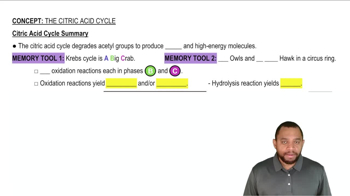
Why, do you suppose, the coenzyme for the reaction in the citric acid cycle that is catalyzed by succinate dehydrogenase is FAD and not NAD+?
Look ahead to Figure 21.8 for the citric acid cycle.
<IMAGE>
b. What class of enzymes carry out these reactions?
The reduced coenzymes NADH and FADH2 are oxidized in the ETS. What is the final electron acceptor of the ETS? What is the function of the H+ ion in ATP synthesis?
Identify the participants in the citric acid cycle that contain alcohol groups. Identify these groups as primary, secondary, or tertiary alcohols.
Each of these reactions is involved in one of the four stages of metabolism shown in Figure 21.4. Identify the stage in which each reaction occurs.
<IMAGE>
a. Hydrolysis of starch to produce glucose