Why, do you suppose, the coenzyme for the reaction in the citric acid cycle that is catalyzed by succinate dehydrogenase is FAD and not NAD+?
Ch.21 The Generation of Biochemical Energy
McMurry8th EditionFundamentals of General, Organic, and Biological ChemistryISBN: 9780134015187Not the one you use?Change textbook
Chapter 21, Problem 14
Identify the participants in the citric acid cycle that contain alcohol groups. Identify these groups as primary, secondary, or tertiary alcohols.
Verified step by step guidance1
Understand the citric acid cycle: The citric acid cycle (also known as the Krebs cycle or TCA cycle) is a series of chemical reactions used by aerobic organisms to generate energy. It involves several intermediates, some of which contain alcohol functional groups (-OH).
Review the structure of each intermediate in the citric acid cycle: Key intermediates include citrate, isocitrate, α-ketoglutarate, succinyl-CoA, succinate, fumarate, malate, and oxaloacetate. Focus on identifying those with alcohol groups.
Identify intermediates with alcohol groups: Examine the molecular structures of the intermediates. Citrate and isocitrate are the two intermediates in the cycle that contain alcohol groups (-OH).
Classify the alcohol groups: Determine the type of alcohol group based on the carbon atom to which the -OH group is attached. A primary alcohol has the -OH group attached to a carbon bonded to one other carbon, a secondary alcohol is attached to a carbon bonded to two other carbons, and a tertiary alcohol is attached to a carbon bonded to three other carbons. For example, citrate contains tertiary alcohol groups, while isocitrate contains secondary alcohol groups.
Summarize the findings: Conclude that citrate and isocitrate are the participants in the citric acid cycle that contain alcohol groups, and classify these groups as tertiary (citrate) and secondary (isocitrate) alcohols.

Verified video answer for a similar problem:
This video solution was recommended by our tutors as helpful for the problem above.
Video duration:
2mWas this helpful?
Key Concepts
Here are the essential concepts you must grasp in order to answer the question correctly.
Citric Acid Cycle
The citric acid cycle, also known as the Krebs cycle, is a series of chemical reactions used by all aerobic organisms to generate energy. It takes place in the mitochondria and involves the oxidation of acetyl-CoA to produce ATP, NADH, and FADH2. Understanding this cycle is crucial for identifying the specific metabolites that contain alcohol groups.
Recommended video:
Guided course
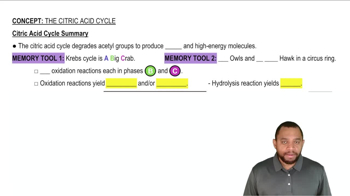
Citric Acid Cycle Summary Concept 12
Alcohol Functional Groups
Alcohols are organic compounds characterized by the presence of one or more hydroxyl (-OH) groups. They can be classified as primary, secondary, or tertiary based on the carbon atom to which the hydroxyl group is attached. This classification is important for understanding the reactivity and properties of the alcohols present in the citric acid cycle.
Recommended video:
Guided course
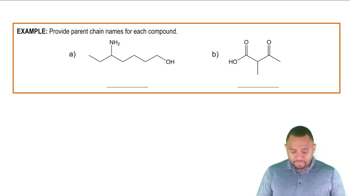
Functional Group Priorities Example 1
Classification of Alcohols
The classification of alcohols into primary, secondary, and tertiary is based on the number of carbon atoms bonded to the carbon with the hydroxyl group. Primary alcohols have one carbon, secondary have two, and tertiary have three. This distinction is essential for identifying the specific alcohol groups in the citric acid cycle participants and understanding their biochemical roles.
Recommended video:
Guided course
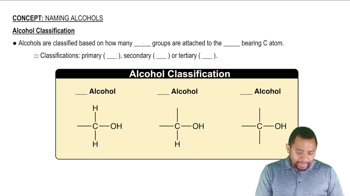
Alcohol Classification Concept 2
Related Practice
Textbook Question
Textbook Question
Look ahead to Figure 21.8 for the citric acid cycle.
<IMAGE>
b. What class of enzymes carry out these reactions?
Textbook Question
Look ahead to Figure 21.8 for the citric acid cycle.
<IMAGE>
a. Draw the structures of the reactants in steps 3, 6, and 8, and indicate which hydrogen atoms are removed in these reactions.
Textbook Question
Which of the reactants in the citric acid cycle have two chiral carbon atoms?
Textbook Question
The reduced coenzymes NADH and FADH2 are oxidized in the ETS. What is the final electron acceptor of the ETS? What is the function of the H+ ion in ATP synthesis?
Textbook Question
Each of these reactions is involved in one of the four stages of metabolism shown in Figure 21.4. Identify the stage in which each reaction occurs.
<IMAGE>
a. Hydrolysis of starch to produce glucose
1
views