Assume that you have samples of the following two compounds, both with formula C7H8O. Both compounds dissolve in ether, but only one of the two dissolves in aqueous NaOH. How could you use this information to distinguish between them?
Ch.14 Some Compounds with Oxygen, Sulfur, or a Halogen
McMurry8th EditionFundamentals of General, Organic, and Biological ChemistryISBN: 9780134015187Not the one you use?Change textbook
Chapter 14, Problem 46e
The following alkenes can be prepared by dehydration of an appropriate alcohol. Show the structure of the alcohol in each case that would provide the alkene shown as the major product.
e. 1,4-Pentadiene
Verified step by step guidance1
Identify the alkene structure: 1,4-Pentadiene is a diene with double bonds located between carbons 1 and 2, and carbons 4 and 5 in a five-carbon chain. The structure is CH₂=CH-CH₂-CH=CH₂.
Recall the dehydration reaction: Dehydration of an alcohol involves the removal of a water molecule (H₂O) to form a double bond. This typically occurs under acidic conditions and heat.
Determine the alcohol precursor for each double bond: For the double bond between carbons 1 and 2, the alcohol precursor would have an -OH group on carbon 1. For the double bond between carbons 4 and 5, the alcohol precursor would have an -OH group on carbon 4.
Combine the alcohol precursors: The alcohol that would yield 1,4-Pentadiene as the major product must have hydroxyl groups (-OH) on both carbon 1 and carbon 4. The structure of the alcohol is HO-CH₂-CH₂-CH₂-CH(OH)-CH₃.
Verify the reaction: When this alcohol undergoes dehydration, the removal of water molecules from carbons 1 and 2, and carbons 4 and 5, will result in the formation of 1,4-Pentadiene as the major product.

Verified video answer for a similar problem:
This video solution was recommended by our tutors as helpful for the problem above.
Was this helpful?
Key Concepts
Here are the essential concepts you must grasp in order to answer the question correctly.
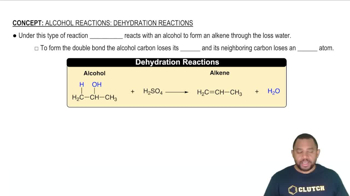
Dehydration Reaction
A dehydration reaction involves the removal of a water molecule from an alcohol, resulting in the formation of an alkene. This process typically requires an acid catalyst and can lead to the formation of multiple products, but the major product is determined by the stability of the resulting alkene, often following Zaitsev's rule.
Recommended video:
Guided course
Alcohol Reactions: Dehydration Reactions Concept 1
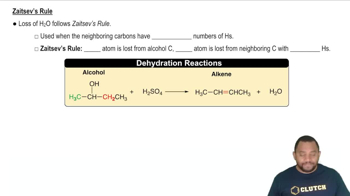
Zaitsev's Rule
Zaitsev's rule states that in elimination reactions, the more substituted alkene is usually the major product. This is because more substituted alkenes are generally more stable due to hyperconjugation and the inductive effect, making it essential to consider the structure of the alcohol to predict the major alkene formed.
Recommended video:
Guided course
Zaitsev’s Rule Concept 2
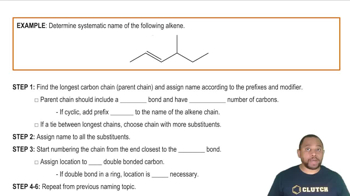
Structure of Alkenes
Alkenes are hydrocarbons that contain at least one carbon-carbon double bond. The structure of an alkene, such as 1,4-pentadiene, is crucial for understanding how to derive the corresponding alcohol. The positioning of the double bonds in the alkene influences the choice of alcohol for dehydration, as the alcohol must have the appropriate carbon skeleton to yield the desired alkene.
Recommended video:
Guided course
Naming Alkenes Example 1
Related Practice
Textbook Question
Textbook Question
Oxidation of a dithiol such as 2,5-hexanedithiol forms a six-membered ring containing a disulfide group as part of the ring. Draw the structure of this cyclic disulfide (Hint: Draw the starting compound in line structure format first).
Textbook Question
What is the structural relationship between a thiol and an alcohol?
Textbook Question
Which of the following alcohols can undergo oxidation? Draw the line structure of the product expected for those that can. Assume an excess of oxidizing agent is present.
a.
b.
c.
Textbook Question
What type of product is formed on reaction of an alcohol with Na metal?
Textbook Question
What alcohols would you oxidize to obtain the following carbonyl compounds?
a.
b.
c.
