Assume that you have samples of the following two compounds, both with formula C7H8O. Both compounds dissolve in ether, but only one of the two dissolves in aqueous NaOH. How could you use this information to distinguish between them?
Ch.14 Some Compounds with Oxygen, Sulfur, or a Halogen
McMurry8th EditionFundamentals of General, Organic, and Biological ChemistryISBN: 9780134015187Not the one you use?Change textbook
Chapter 14, Problem 40c
Draw the structures of the aldehydes that might be oxidized to yield the following carboxylic acids:
c. CH3CH=CHCOOH
Verified step by step guidance1
Step 1: Understand the relationship between aldehydes and carboxylic acids. Aldehydes can be oxidized to form carboxylic acids. The oxidation process involves the addition of an oxygen atom to the carbonyl carbon of the aldehyde, converting it into a carboxylic acid group (-COOH).
Step 2: Analyze the given carboxylic acid structure, CH3CH=CHCOOH. This structure contains a carboxylic acid group (-COOH) attached to a chain with a double bond (CH=CH) and a methyl group (CH3).
Step 3: To determine the aldehyde precursor, replace the carboxylic acid group (-COOH) with an aldehyde group (-CHO). This involves removing the hydroxyl group (-OH) from the carboxylic acid and replacing it with a hydrogen atom.
Step 4: Write the structure of the aldehyde. The aldehyde corresponding to CH3CH=CHCOOH will have the structure CH3CH=CHCHO. This structure retains the double bond and methyl group while replacing the carboxylic acid group with an aldehyde group.
Step 5: Verify the structure by considering the oxidation process. Oxidizing CH3CH=CHCHO (the aldehyde) would add an oxygen atom to the carbonyl carbon, converting it into CH3CH=CHCOOH (the carboxylic acid). This confirms the aldehyde structure is correct.

Verified video answer for a similar problem:
This video solution was recommended by our tutors as helpful for the problem above.
Was this helpful?
Key Concepts
Here are the essential concepts you must grasp in order to answer the question correctly.
Aldehydes
Aldehydes are organic compounds characterized by the presence of a carbonyl group (C=O) bonded to at least one hydrogen atom. They are typically represented by the general formula RCHO, where R is a hydrocarbon chain. Aldehydes can be oxidized to form carboxylic acids, making them important in organic synthesis and reactions.
Recommended video:
Guided course
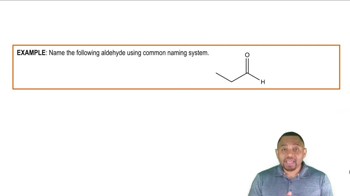
Naming Aldehydes Example 2
Oxidation Reactions
Oxidation reactions involve the loss of electrons or an increase in oxidation state by a molecule, atom, or ion. In the context of aldehydes, oxidation typically converts them into carboxylic acids. Common oxidizing agents include potassium permanganate and chromium trioxide, which facilitate this transformation by adding oxygen or removing hydrogen.
Recommended video:
Guided course
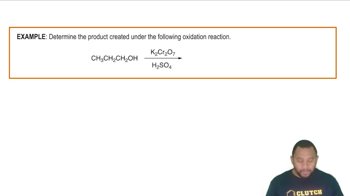
Alcohol Reactions Oxidation Reactions Example 1
Carboxylic Acids
Carboxylic acids are organic compounds that contain a carboxyl group (-COOH). They are known for their acidic properties and are formed from the oxidation of aldehydes. The structure of carboxylic acids includes a carbon atom double-bonded to an oxygen atom and single-bonded to a hydroxyl group, which contributes to their reactivity and solubility in water.
Recommended video:
Guided course
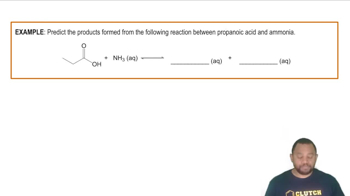
Carboxylic Acid Reactions Example 1
Related Practice
Textbook Question
Textbook Question
Identify each alcohol named in Problem 14.32 as primary, secondary, or tertiary.
a.
b.
c.
d.
e.
f.
Textbook Question
Which of the following alcohols can undergo oxidation? Draw the line structure of the product expected for those that can. Assume an excess of oxidizing agent is present.
a.
b.
c.
Textbook Question
What type of product is formed on reaction of an alcohol with Na metal?
Textbook Question
Draw structures corresponding to the following names:
f. 3-Methoxy-4-methyl-1-pentene
1
views
Textbook Question
Arrange the following 6-carbon compounds in order of their expected boiling points, and explain your ranking:
a. Hexane
b. 1-Hexanol
c. Dipropyl ether (CH3CH2CH2—O—CH2CH2CH3)
