
Textbook Question
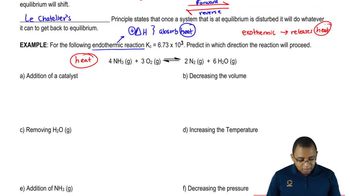
When the following equilibria are disturbed by increasing the pressure, does the concentration of reaction products increase, decrease, or remain the same?
a. 2 CO2(g) ⇌ 2 CO(g) + O2(g)
3
views
 Verified step by step guidance
 09:34
09:34
 02:38
02:38 02:50
02:50When the following equilibria are disturbed by increasing the pressure, does the concentration of reaction products increase, decrease, or remain the same?
a. 2 CO2(g) ⇌ 2 CO(g) + O2(g)
The reaction H2(g) + I2(g) ⇌ 2 HI(g) has ∆H = -2.2 kcal/mol (-9.2 kJ/mol). Will the equilibrium concentration of HI increase or decrease when
c. A catalyst is added?
Hydrogen chloride can be made from the reaction of chlorine and hydrogen:
Cl2(g) + H2(g) → 2 HCl(g)
For this reaction, K = 26 × 1033 and ∆H = -44 kcal/mol(-184 kJ/mol) at 25 °C.
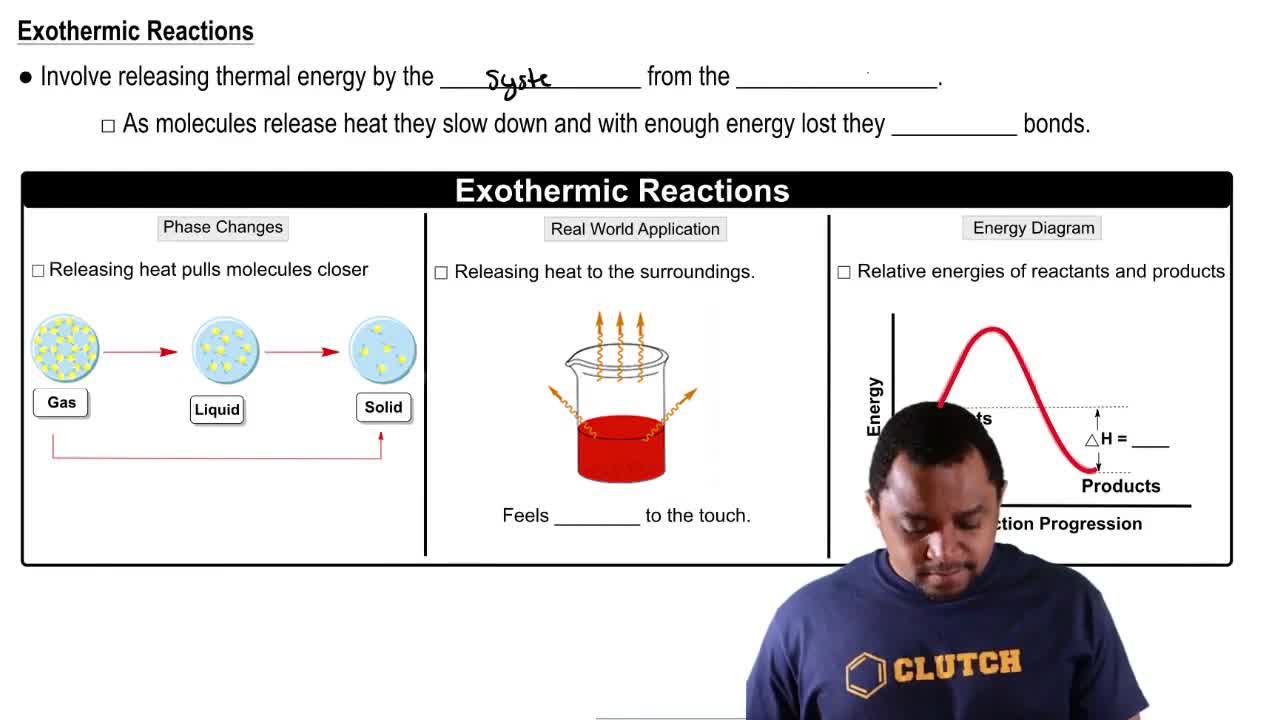
a. Is the reaction endothermic or exothermic?
For the following equilibria, use Le Châtelier's principle to predict the direction of the reaction when the pressure is increased by decreasing the volume of the equilibrium mixture.
a. C(s) + H2O(g) ⇌ CO(g) + H2(g)
The reaction Fe3+(aq) + Cl-(aq) ⇌ FeCl2+(aq) is endothermic. How will the equilibrium concentration of FeCl2+ change when
b. Cl- is precipitated by addition of AgNO3?
The reaction H2(g) + I2(g) ⇌ 2 HI(g) has ∆H = -2.2 kcal/mol (-9.2 kJ/mol). Will the equilibrium concentration of HI increase or decrease when
b. H2 is removed?