Oxygen can be converted into ozone by the action of lightning or electric sparks:
3 O2(g) ⇌ 2 O3(g)
For this reaction, ∆H = +69kcal/mol (+285 kj/mol) and K = 2.68 × 10⁻²⁹ at 25 °C.
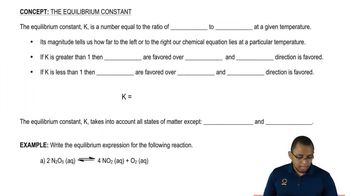
b. Are the reactants or the products favored at equilibrium?
Verified step by step guidance
Oxygen can be converted into ozone by the action of lightning or electric sparks:
3 O2(g) ⇌ 2 O3(g)
For this reaction, ∆H = +69kcal/mol (+285 kj/mol) and K = 2.68 × 10⁻²⁹ at 25 °C.
b. Are the reactants or the products favored at equilibrium?
The reaction CO(g) + H2O(g) ⇌ CO2(g) + H2(g) has ∆H = -9.8 kcal/mol (-41 kJ/mol). Does the amount of H2 in an equilibrium mixture increase or decrease when the temperature is decreased?
Use your answer from Problem 7.54 to calculate the following:
a. [O2] at equilibrium when [CO2] = 0.18 mol/L and [CO] = 0.0200 mol/L
When the following equilibria are disturbed by increasing the pressure, does the concentration of reaction products increase, decrease, or remain the same?
a. 2 CO2(g) ⇌ 2 CO(g) + O2(g)
For the following equilibria, use Le Châtelier's principle to predict the direction of the reaction when the pressure is increased by decreasing the volume of the equilibrium mixture.
a. C(s) + H2O(g) ⇌ CO(g) + H2(g)
Oxygen can be converted into ozone by the action of lightning or electric sparks:
3 O2(g) ⇌ 2 O3(g)
For this reaction, ∆H = +69kcal/mol (+285 kj/mol) and K = 2.68 × 10⁻²⁹ at 25 °C.
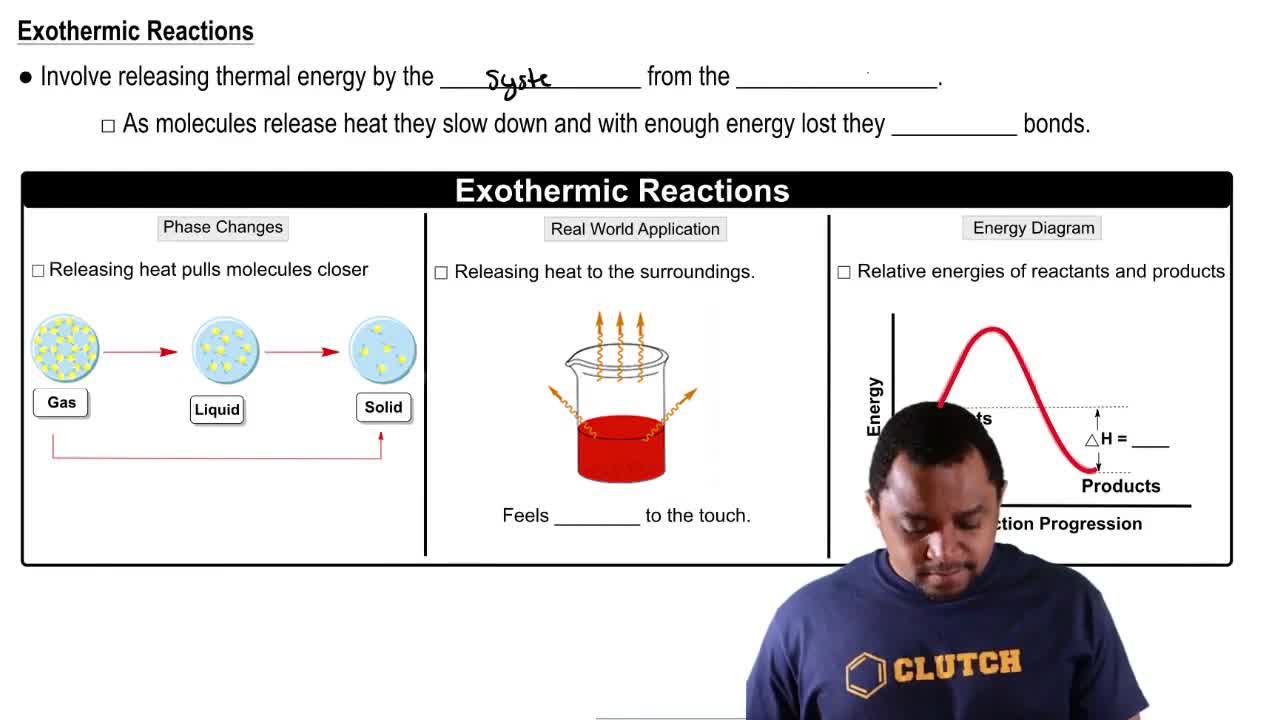
a. Is the reaction exothermic or endothermic?