Pentoses also exist in a ring form, but they most commonly occur as furanose rings. D-Ribose exists in its furanose ring form in the nucleic acid RNA. Using the structure of D-ribose from Table 6.1, draw the furanose form of β-D-ribose.
Ch.6 Carbohydrates Life's Sweet Molecules
Frost4th EditionGeneral, Organic and Biological ChemistryISBN: 9780134988696Not the one you use?Change textbook
Chapter 3, Problem 30
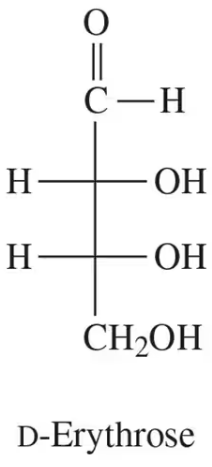
The sugar alcohol erythritol is often included in low-calorie sweeteners. It is 70% as sweet as table sugar. Erythritol is the reduced form of the aldotetrose erythrose. Draw erythritol.

Verified step by step guidance1
Understand the problem: Erythritol is the reduced form of d-Erythrose, which means the aldehyde group in d-Erythrose is reduced to a hydroxyl group, converting it into a sugar alcohol.
Identify the structure of d-Erythrose: d-Erythrose is an aldotetrose, meaning it has four carbon atoms, one of which is part of an aldehyde group (-CHO), and the remaining carbons have hydroxyl groups (-OH) attached in a specific stereochemical arrangement.
Apply the reduction process: Reduction of the aldehyde group (-CHO) in d-Erythrose involves converting it into a primary alcohol (-CH2OH). This results in erythritol, which is a sugar alcohol with four carbons, each having a hydroxyl group (-OH).
Draw the structure of erythritol: Arrange the four carbon atoms in a chain. Attach a hydroxyl group (-OH) to each carbon atom, ensuring the stereochemistry matches that of d-Erythrose. The first carbon will have a -CH2OH group instead of the aldehyde group.
Verify the stereochemistry: Ensure that the hydroxyl groups (-OH) on the second and third carbons retain the same stereochemical configuration as in d-Erythrose, as the reduction process does not alter the stereochemistry of these carbons.

Verified video answer for a similar problem:
This video solution was recommended by our tutors as helpful for the problem above.
Video duration:
2mWas this helpful?
Key Concepts
Here are the essential concepts you must grasp in order to answer the question correctly.
Erythritol
Erythritol is a sugar alcohol used as a low-calorie sweetener, providing about 70% of the sweetness of table sugar with significantly fewer calories. It is naturally found in some fruits and fermented foods. Erythritol is known for its digestive tolerance compared to other sugar alcohols, making it a popular choice for those seeking to reduce sugar intake without sacrificing sweetness.
Chemical Structure
Erythritol is a four-carbon sugar alcohol, specifically the reduced form of the aldotetrose erythrose. Its chemical structure includes a hydroxyl group (-OH) on each carbon, which classifies it as a polyol. Understanding its molecular structure is essential for grasping its properties, including its sweetness and caloric content.
Recommended video:
Guided course
Chemical Reaction: Chemical Change Concept 1
Sweetness Comparison
The sweetness of erythritol, at 70% that of sucrose (table sugar), highlights its role in low-calorie diets. This comparison is crucial for consumers and food manufacturers looking to replace sugar while maintaining flavor. The lower sweetness level also means that erythritol can be used in combination with other sweeteners to achieve desired taste profiles without excessive calories.
Recommended video:
Guided course
Thermochemical Equations
Related Practice
Textbook Question
Textbook Question
Identify the following carbohydrates as the ⍺ or β anomer:
(a)
Textbook Question
Name the glycosidic bond present in mannobiose, shown in the following figure:
Textbook Question
Identify the following reactions as condensation or hydrolysis:
(a) two monosaccharides reacting to form a disaccharide
Textbook Question
Draw the ⍺ and β anomer of D-talose in pyranose ring form:
Textbook Question
The sugar alcohol ribitol is a component of the vitamin riboflavin and the energy transfer molecule FAD. Ribitol is formed when the monosaccharide ribose undergoes reduction at carbon 1. Draw the structure of ribitol.
