Skip to main content
GOB Chemistry
My Course
Learn
Exam Prep
AI Tutor
Study Guides
Textbook Solutions
Flashcards
Explore
Try the app
My Course
Learn
Exam Prep
AI Tutor
Study Guides
Textbook Solutions
Flashcards
Explore
Try the app
Back
Triacylglycerol Reactions: Hydrolysis quiz
You can tap to flip the card.
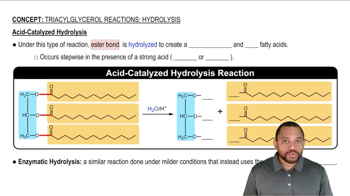
What are the products of acid-catalyzed hydrolysis of triacylglycerol?
You can tap to flip the card.
👆
What are the products of acid-catalyzed hydrolysis of triacylglycerol?
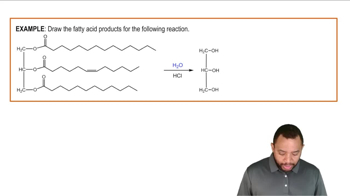
The products are one glycerol molecule and three fatty acids.
Track progress
Control buttons has been changed to "navigation" mode.
1/15
Related flashcards
Related practice
Recommended videos
Triacylglycerol Reactions: Hydrolysis definitions
Triacylglycerol Reactions: Hydrolysis
15 Terms
Triacylglycerol Reactions: Hydrolysis
23. Lipids
6 problems
Topic
Ernest
Triacylglycerol Reactions: Oxidation
23. Lipids
1 problem
Topic
23. Lipids - Part 1 of 3
6 topics
13 problems
Chapter
Ernest
23. Lipids - Part 2 of 3
6 topics
12 problems
Chapter
Nicole
23. Lipids - Part 3 of 3
1 topic
3 problems
Chapter
Guided course
1:48
Triacylglycerol Reactions: Hydrolysis Example 1
3
views
Guided course
3:09
Triacylglycerol Reactions: Hydrolysis Concept 1
2
views
Guided course
2:17
Triacylglycerol Reactions: Hydrolysis Example 2
1
views
Terms in this set (15)
Hide definitions
What are the products of acid-catalyzed hydrolysis of triacylglycerol?
The products are one glycerol molecule and three fatty acids.
Which strong acids are commonly used in acid-catalyzed hydrolysis of triacylglycerol?
Hydrochloric acid (HCl) and sulfuric acid (H2SO4) are commonly used.
Does acid-catalyzed hydrolysis of triacylglycerol release all three fatty acids at once?
No, the fatty acids are released stepwise, one at a time.
What happens to the ester linkage during acid-catalyzed hydrolysis?
The ester linkage is broken, with water adding a hydrogen to the glycerol oxygen and a hydroxyl group to the fatty acid carbonyl carbon.
What is the role of water in acid-catalyzed hydrolysis of triacylglycerol?
Water provides the hydrogen and hydroxyl groups needed to break the ester bonds and form glycerol and fatty acids.
What enzyme is used in enzymatic hydrolysis of triacylglycerol?
The enzyme lipase is used in enzymatic hydrolysis.
How do the products of enzymatic hydrolysis compare to acid-catalyzed hydrolysis?
Both produce glycerol and three fatty acids as end products.
What is saponification?
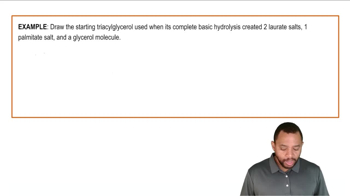
Saponification is base-catalyzed hydrolysis of triacylglycerol, producing glycerol and salts of fatty acids.
Which base is commonly used in saponification to make solid soap?
Sodium hydroxide (NaOH) is used to make solid soap.
What are the products of saponification?
The products are glycerol and three carboxylate anions (salts of fatty acids).
What type of soap is produced when potassium hydroxide is used in saponification?
Potassium hydroxide (KOH) produces liquid soap.
What is the significance of the carboxylate anions formed during saponification?
They are the soap precursors, combining with metal ions to form soap.
How does the base in saponification affect the physical state of the soap produced?
Sodium hydroxide produces solid soap, while potassium hydroxide produces liquid soap.
What is the main difference between acid-catalyzed and base-catalyzed hydrolysis of triacylglycerol?
Acid-catalyzed hydrolysis produces fatty acids, while base-catalyzed hydrolysis (saponification) produces fatty acid salts.
Why is saponification important in everyday life?
Saponification is important because it is the chemical process used to make soaps from fats and oils.
 BackBack

 1:48
1:48