Skip to main content
GOB Chemistry
My Course
Learn
Exam Prep
AI Tutor
Study Guides
Textbook Solutions
Flashcards
Explore
Try the app
My Course
Learn
Exam Prep
AI Tutor
Study Guides
Textbook Solutions
Flashcards
Explore
Try the app
Back
Triacylglycerol Reactions: Hydrolysis definitions
You can tap to flip the card.
Triacylglycerol
You can tap to flip the card.
👆
Triacylglycerol
A molecule composed of glycerol bonded to three fatty acids via ester linkages; main storage form of fats.
Track progress
Control buttons has been changed to "navigation" mode.
1/15
Related flashcards
Related practice
Recommended videos
Triacylglycerol Reactions: Hydrolysis quiz
Triacylglycerol Reactions: Hydrolysis
15 Terms
Triacylglycerol Reactions: Hydrolysis
23. Lipids
6 problems
Topic
Ernest
Triacylglycerol Reactions: Oxidation
23. Lipids
1 problem
Topic
23. Lipids - Part 1 of 3
6 topics
13 problems
Chapter
Ernest
23. Lipids - Part 2 of 3
6 topics
12 problems
Chapter
Nicole
23. Lipids - Part 3 of 3
1 topic
3 problems
Chapter
Guided course
1:48
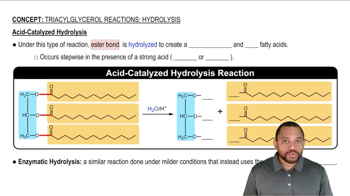
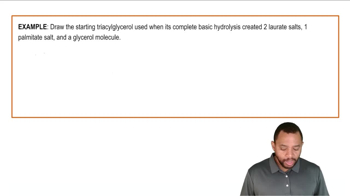
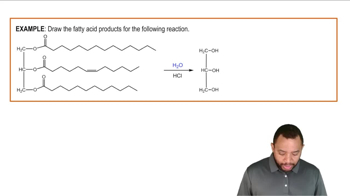
Triacylglycerol Reactions: Hydrolysis Example 1
3
views
Guided course
3:09
Triacylglycerol Reactions: Hydrolysis Concept 1
2
views
Guided course
2:17
Triacylglycerol Reactions: Hydrolysis Example 2
1
views
Terms in this set (15)
Hide definitions
Triacylglycerol
A molecule composed of glycerol bonded to three fatty acids via ester linkages; main storage form of fats.
Hydrolysis
A reaction where water breaks chemical bonds, specifically splitting ester linkages in fats to yield smaller molecules.
Ester Bond
A chemical linkage joining fatty acids to glycerol, cleaved during fat breakdown reactions.
Glycerol
A three-carbon alcohol formed as a product when fats are hydrolyzed, serving as a backbone for fatty acids.
Fatty Acid
A molecule with a hydrocarbon tail and a carboxylic acid group, released from fats during hydrolysis.
Acid Catalyzed Hydrolysis
A process using strong acids to break ester bonds in fats, producing glycerol and free fatty acids.
Enzymatic Hydrolysis
A mild reaction using lipase to split fats into glycerol and fatty acids, mimicking digestive processes.
Lipase
A digestive enzyme that accelerates the breakdown of fats into glycerol and fatty acids under gentle conditions.
Saponification
A base-driven reaction that splits fats, yielding glycerol and fatty acid salts, foundational for soap production.
Sodium Hydroxide
A strong base used in saponification, leading to the formation of solid soaps from fats.
Potassium Hydroxide
A base that, when used in saponification, results in the production of liquid soaps.
Carboxylic Acid
A functional group formed on fatty acids after acid hydrolysis, characterized by a carbonyl and hydroxyl group.
Carboxylate Anion
A negatively charged species formed when fatty acids react with base, serving as a soap precursor.
Soap
A cleaning agent produced from the salts of fatty acids, generated during the saponification of fats.
Hydroxide Ion
A negatively charged ion from bases that attacks ester bonds in fats during saponification.
 BackBack

 1:48
1:48