Back

Triacylglycerol Reactions: Hydrogenation quiz

Control buttons has been changed to "navigation" mode.
1/15
  • What is added to pi bonds during hydrogenation of triacylglycerols?

    Hydrogen (H2) is added to pi bonds during hydrogenation.
  • What effect does hydrogenation have on the unsaturation of triacylglycerols?

    Hydrogenation decreases unsaturation by converting double bonds to single bonds.
  • How does hydrogenation affect the melting point of triacylglycerols?

    Hydrogenation increases the melting point by reducing unsaturation.
  • What is complete hydrogenation?

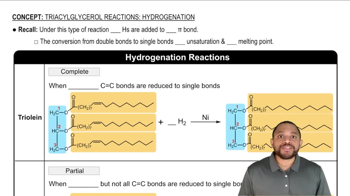
    Complete hydrogenation is when all carbon-carbon double bonds are reduced to single bonds.
  • How many moles of hydrogen are needed for each pi bond in hydrogenation?

    One mole of hydrogen (H2) is required for each pi bond.
  • What is the name of a triacylglycerol molecule with three double bonds?

    Trioline is a triacylglycerol molecule with three double bonds.
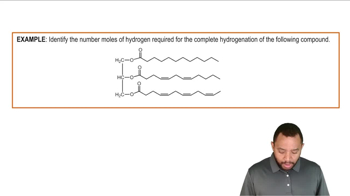
  • How many moles of hydrogen are needed to completely hydrogenate trioline?

    Three moles of hydrogen are needed to completely hydrogenate trioline.
  • What is partial hydrogenation?

    Partial hydrogenation is when only some, but not all, carbon-carbon double bonds are reduced to single bonds.
  • Why is partial hydrogenation used commercially?

    Partial hydrogenation is used to adjust the consistency of products like margarines by controlling the number of remaining pi bonds.
  • What determines the hardness of margarine after partial hydrogenation?

    The number of pi bonds remaining determines the hardness of margarine.
  • What metal catalyst is commonly used in hydrogenation reactions?

    Nickel is commonly used as a metal catalyst in hydrogenation reactions.
  • How many moles of hydrogen are needed if two pi bonds are removed during partial hydrogenation?

    Two moles of hydrogen are needed if two pi bonds are removed.
  • What happens to fatty acid chains after complete hydrogenation?

    After complete hydrogenation, fatty acid chains become fully single-bonded.
  • What is the main difference between complete and partial hydrogenation?

    Complete hydrogenation removes all double bonds, while partial hydrogenation leaves some double bonds intact.
  • How do companies use partial hydrogenation to create different types of margarine?

    Companies control the number of pi bonds remaining to produce margarines with varying hardness.