Back

Triacylglycerol Reactions: Hydrogenation definitions

Control buttons has been changed to "navigation" mode.
1/13
  • Triacylglycerol

    A molecule composed of three fatty acid chains attached to a glycerol backbone, commonly found in fats and oils.
  • Hydrogenation

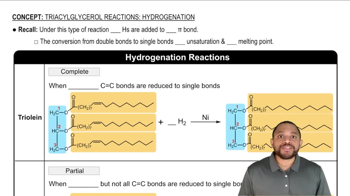
    A chemical process where hydrogen atoms are added to unsaturated bonds, converting double bonds to single bonds in fatty acids.
  • Pi Bond

    A type of covalent bond formed from the sideways overlap of p orbitals, present in double bonds of unsaturated fatty acids.
  • Unsaturation

    A characteristic of molecules containing one or more double bonds, leading to increased fluidity and lower melting points.
  • Melting Point

    The temperature at which a solid fat becomes liquid, influenced by the degree of unsaturation in fatty acid chains.
  • Complete Hydrogenation

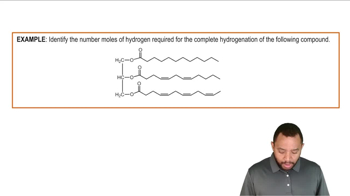
    A process where all double bonds in a molecule are converted to single bonds, resulting in fully saturated fatty acid chains.
  • Partial Hydrogenation

    A process where only some double bonds are converted to single bonds, allowing control over the final product's consistency.
  • Nickel Catalyst

    A metal substance used to speed up the addition of hydrogen to double bonds during hydrogenation reactions.
  • Triglyceride

    A synonym for triacylglycerol, representing a fat molecule with three fatty acid chains esterified to glycerol.
  • Trioline

    A specific triacylglycerol molecule containing three double bonds, often used as an example in hydrogenation reactions.
  • Fatty Acid Chain

    A long hydrocarbon tail attached to glycerol in fats, whose saturation level affects physical properties like hardness.
  • Margarine

    A commercially produced spread made by partially hydrogenating oils, with consistency determined by remaining double bonds.
  • Saturation

    A state where all carbon atoms in fatty acid chains are connected by single bonds, resulting from complete hydrogenation.