Skip to main content
GOB Chemistry
My Course
Learn
Exam Prep
AI Tutor
Study Guides
Textbook Solutions
Flashcards
Explore
Try the app
My Course
Learn
Exam Prep
AI Tutor
Study Guides
Textbook Solutions
Flashcards
Explore
Try the app
Back
The Ideal Gas Law Applications quiz
You can tap to flip the card.
What is the formula for the ideal gas law?
You can tap to flip the card.
👆
What is the formula for the ideal gas law?
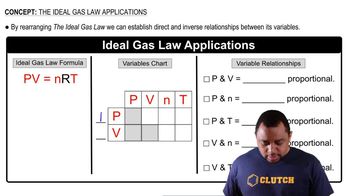
The formula is PV = nRT, where P is pressure, V is volume, n is moles, R is the gas constant, and T is temperature.
Track progress
Control buttons has been changed to "navigation" mode.
1/15
Related flashcards
Related practice
Recommended videos
The Ideal Gas Law Applications definitions
The Ideal Gas Law Applications
12 Terms
The Ideal Gas Law Applications
8. Gases, Liquids and Solids
4 problems
Topic
Jules
Chemistry Gas Laws
8. Gases, Liquids and Solids
6 problems
Topic
Jules
8. Gases, Liquids and Solids - Part 1 of 2
8 topics
15 problems
Chapter
Jules
8. Gases, Liquids and Solids - Part 2 of 2
7 topics
15 problems
Chapter
Jules
Guided course
01:09
The Ideal Gas Law Applications Example 1
15
views
Guided course
04:09
The Ideal Gas Law Applications
28
views
Terms in this set (15)
Hide definitions
What is the formula for the ideal gas law?
The formula is PV = nRT, where P is pressure, V is volume, n is moles, R is the gas constant, and T is temperature.
Which variable in the ideal gas law is considered a constant?
R, the gas constant, is considered a constant in the ideal gas law.
How are pressure and volume related in the ideal gas law?
Pressure and volume are inversely proportional; as one increases, the other decreases.
What happens to pressure if volume increases, assuming other variables are constant?
If volume increases, pressure decreases due to their inverse relationship.
How are pressure and moles related in the ideal gas law?
Pressure and moles are directly proportional; increasing one increases the other.
If the number of moles increases, what happens to the pressure (with other variables constant)?
Pressure increases because it is directly proportional to the number of moles.
Describe the relationship between pressure and temperature in the ideal gas law.
Pressure and temperature are directly proportional; both increase or decrease together.
What is the effect on pressure if temperature increases, assuming other variables are constant?
Pressure increases because it is directly proportional to temperature.
How are volume and moles related in the ideal gas law?
Volume and moles are directly proportional; an increase in one results in an increase in the other.
If the number of moles decreases, what happens to the volume (with other variables constant)?
Volume decreases because it is directly proportional to the number of moles.
Describe the relationship between volume and temperature in the ideal gas law.
Volume and temperature are directly proportional; they increase or decrease together.
What happens to volume if temperature decreases, assuming other variables are constant?
Volume decreases because it is directly proportional to temperature.
Which pair of variables in the ideal gas law has an inverse relationship?
Pressure and volume are the only pair with an inverse relationship.
Why are pressure and volume inversely proportional in the ideal gas law?
Because when one increases, the other must decrease to keep the product PV constant if n, R, and T are unchanged.
How can understanding variable relationships in the ideal gas law help solve theoretical questions?
It helps predict how changing one variable affects another, making it easier to solve problems involving gas behavior.
 BackBack
 01:09
01:09