Skip to main content
GOB Chemistry
My Course
Learn
Exam Prep
AI Tutor
Study Guides
Textbook Solutions
Flashcards
Explore
Try the app
My Course
Learn
Exam Prep
AI Tutor
Study Guides
Textbook Solutions
Flashcards
Explore
Try the app
Back
The Ideal Gas Law Applications definitions
You can tap to flip the card.
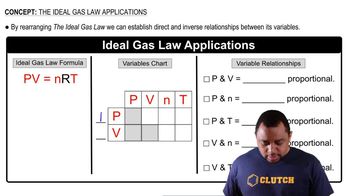
Ideal Gas Law
You can tap to flip the card.
👆
Ideal Gas Law
A mathematical relationship connecting pressure, volume, moles, gas constant, and temperature for gases.
Track progress
Control buttons has been changed to "navigation" mode.
1/12
Related flashcards
Related practice
Recommended videos
The Ideal Gas Law Applications quiz
The Ideal Gas Law Applications
15 Terms
The Ideal Gas Law Applications
8. Gases, Liquids and Solids
4 problems
Topic
Jules
Chemistry Gas Laws
8. Gases, Liquids and Solids
6 problems
Topic
Jules
8. Gases, Liquids and Solids - Part 1 of 2
8 topics
15 problems
Chapter
Jules
8. Gases, Liquids and Solids - Part 2 of 2
7 topics
15 problems
Chapter
Jules
Guided course
01:09
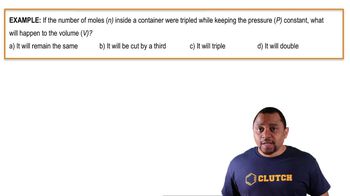
The Ideal Gas Law Applications Example 1
15
views
Guided course
04:09
The Ideal Gas Law Applications
28
views
Terms in this set (12)
Hide definitions
Ideal Gas Law
A mathematical relationship connecting pressure, volume, moles, gas constant, and temperature for gases.
Pressure
A variable representing the force exerted by gas particles per unit area within a container.
Volume
A variable indicating the amount of space occupied by a gas in a container.
Moles
A measure of the quantity of gas particles present in a sample.
Gas Constant
A fixed value that relates energy, temperature, and amount of gas in the ideal gas law equation.
Temperature
A variable reflecting the average kinetic energy of gas particles in a system.
Direct Proportionality
A relationship where increasing one variable causes another to increase by the same factor.
Inverse Proportionality
A relationship where increasing one variable causes another to decrease proportionally.
Variable Chart
A tool used to compare and analyze the effects of changing one gas law variable on others.
Numerator
A position in the ideal gas law equation indicating variables that increase or decrease together.
Denominator
A position in the ideal gas law equation indicating variables that change in opposition to those in the numerator.
Theoretical Question
A problem type that asks for predictions about variable changes using the relationships in the ideal gas law.
 BackBack
 01:09
01:09