Skip to main content
GOB Chemistry
My Course
Learn
Exam Prep
AI Tutor
Study Guides
Textbook Solutions
Flashcards
Explore
Try the app
My Course
Learn
Exam Prep
AI Tutor
Study Guides
Textbook Solutions
Flashcards
Explore
Try the app
Back
Summary of Lipid Metabolism quiz
You can tap to flip the card.
What central molecule is produced from both lipid and carbohydrate metabolism?
You can tap to flip the card.
👆
What central molecule is produced from both lipid and carbohydrate metabolism?
Acetyl-CoA is produced from both lipid and carbohydrate metabolism.
Track progress
Control buttons has been changed to "navigation" mode.
1/15
Related flashcards
Related practice
Recommended videos
Summary of Lipid Metabolism definitions
Summary of Lipid Metabolism
15 Terms
Summary of Lipid Metabolism
24. Lipid Metabolism
4 problems
Topic
Laura
Ketone Bodies
24. Lipid Metabolism
3 problems
Topic
Laura
24. Lipid Metabolism - Part 1 of 2
8 topics
15 problems
Chapter
KeyshawnDavis
24. Lipid Metabolism - Part 2 of 2
1 topic
3 problems
Chapter
Nicole
Guided course
1:44
Summary of Lipid Metabolism Example 1
3
views
Guided course
5:50
Summary of Lipid Metabolism Concept 1
4
views
Terms in this set (15)
Hide definitions
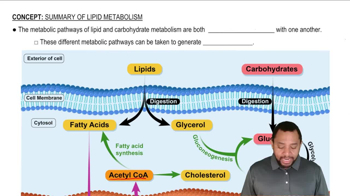
What central molecule is produced from both lipid and carbohydrate metabolism?
Acetyl-CoA is produced from both lipid and carbohydrate metabolism.
What are the main fates of Acetyl-CoA in energy production?
Acetyl-CoA enters the citric acid cycle and oxidative phosphorylation to produce ATP.
Which metabolic pathway uses Acetyl-CoA to form ketone bodies?
The anabolic pathway called ketogenesis uses Acetyl-CoA to form ketone bodies.
How are fatty acids regenerated from Acetyl-CoA?
Acetyl-CoA is shuttled out of the mitochondrial matrix to the cytosol for fatty acid synthesis.
What is the role of catabolic pathways in lipid and carbohydrate metabolism?
Catabolic pathways break down lipids and carbohydrates to produce Acetyl-CoA.
What happens to lipids when they cross the cell membrane?
Lipids are digested into fatty acids and glycerol when they cross the cell membrane.
How do fatty acids enter the mitochondrial matrix?
Fatty acids are transported across the mitochondrial membrane into the matrix.
What process converts fatty acids into Acetyl-CoA?
Beta oxidation converts fatty acids into Acetyl-CoA.
What can happen to Acetyl-CoA if there is an excess in the mitochondrial matrix?
Excess Acetyl-CoA can be shuttled out of the matrix to form fatty acids.
How does glycerol participate in glucose production?
Glycerol can enter gluconeogenesis to help produce glucose.
What is the connection between glycolysis and glycerol?
Glycerol can also enter glycolysis, linking lipid and carbohydrate metabolism.
What happens to glucose after it crosses the cell membrane?
Glucose undergoes glycolysis to form pyruvate.
How is pyruvate converted to Acetyl-CoA?
Pyruvate is transported into the mitochondrial matrix and converted to Acetyl-CoA.
What determines whether Acetyl-CoA forms ketone bodies?
Low carbohydrate levels favor the conversion of Acetyl-CoA into ketone bodies.
Why is Acetyl-CoA considered a central metabolite?
Acetyl-CoA is an end product of glucose, glycerol, and fatty acid metabolism and a starting material for ketone bodies and cholesterol.
 BackBack
 1:44
1:44