Skip to main content
GOB Chemistry
My Course
Learn
Exam Prep
AI Tutor
Study Guides
Textbook Solutions
Flashcards
Explore
Try the app
My Course
Learn
Exam Prep
AI Tutor
Study Guides
Textbook Solutions
Flashcards
Explore
Try the app
Back
Summary of Lipid Metabolism definitions
You can tap to flip the card.
Acetyl-CoA
You can tap to flip the card.
👆
Acetyl-CoA
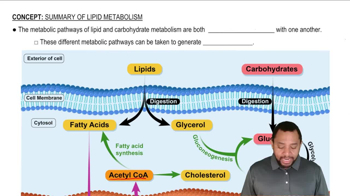
Central molecule linking lipid and carbohydrate metabolism, serving as both a key product and precursor in multiple metabolic pathways.
Track progress
Control buttons has been changed to "navigation" mode.
1/15
Related flashcards
Related practice
Recommended videos
Summary of Lipid Metabolism quiz
Summary of Lipid Metabolism
15 Terms
Summary of Lipid Metabolism
24. Lipid Metabolism
4 problems
Topic
Laura
Ketone Bodies
24. Lipid Metabolism
3 problems
Topic
Laura
24. Lipid Metabolism - Part 1 of 2
8 topics
15 problems
Chapter
KeyshawnDavis
24. Lipid Metabolism - Part 2 of 2
1 topic
3 problems
Chapter
Nicole
Guided course
1:44
Summary of Lipid Metabolism Example 1
3
views
Guided course
5:50
Summary of Lipid Metabolism Concept 1
4
views
Terms in this set (15)
Hide definitions
Acetyl-CoA
Central molecule linking lipid and carbohydrate metabolism, serving as both a key product and precursor in multiple metabolic pathways.
Citric Acid Cycle
Series of reactions in the mitochondrial matrix where Acetyl-CoA is oxidized, producing energy carriers for ATP synthesis.
Oxidative Phosphorylation
Process in mitochondria where energy from electron carriers is used to generate ATP, following the citric acid cycle.
Ketone Bodies
Energy-rich molecules formed from Acetyl-CoA during low carbohydrate availability, exported from mitochondria for use by other tissues.
Fatty Acid Synthesis
Anabolic process in the cytosol where Acetyl-CoA is converted into long-chain fatty acids for energy storage.
Cholesterol Formation
Biosynthetic pathway using Acetyl-CoA to produce a vital lipid component of cell membranes and precursor for steroid hormones.
Catabolic Pathways
Metabolic routes that break down lipids and carbohydrates to generate Acetyl-CoA and release energy.
Anabolic Pathways
Metabolic routes that use Acetyl-CoA to build complex molecules like fatty acids, ketone bodies, and cholesterol.
Beta Oxidation
Mitochondrial process where fatty acids are sequentially broken down to produce Acetyl-CoA.
Gluconeogenesis
Pathway that synthesizes glucose from non-carbohydrate sources such as glycerol and pyruvate, especially during fasting.
Glycolysis
Cytosolic pathway converting glucose into pyruvate, providing substrates for further energy production.
Mitochondrial Matrix
Innermost compartment of mitochondria where key metabolic processes like the citric acid cycle and beta oxidation occur.
Cell Membrane
Barrier regulating the entry and exit of lipids and carbohydrates, initiating their metabolic processing.
Glycerol
Three-carbon molecule derived from lipid digestion, entering gluconeogenesis or glycolysis to link lipid and carbohydrate metabolism.
Pyruvate
Three-carbon intermediate from glycolysis, transported into mitochondria for conversion into Acetyl-CoA or glucose synthesis.
 BackBack
 1:44
1:44