Back

Spontaneous vs Nonspontaneous Reactions quiz

Control buttons has been changed to "navigation" mode.
1/15
  • What is a spontaneous reaction?

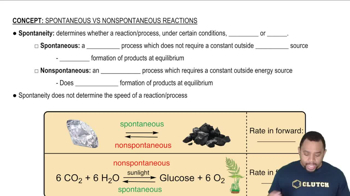
    A spontaneous reaction is a natural process that occurs without a constant outside energy source and favors the formation of products at equilibrium.
  • What is a nonspontaneous reaction?

    A nonspontaneous reaction is an unnatural process that requires a constant outside energy source and favors the reactants at equilibrium.
  • Does spontaneity determine the speed of a reaction?

    No, spontaneity does not determine the speed of a reaction; it only indicates if the reaction can occur naturally.
  • What field of chemistry deals with whether a reaction is spontaneous or not?

    Thermodynamics deals with whether a reaction is spontaneous or nonspontaneous.
  • What field of chemistry deals with the speed of a reaction?

    Kinetics deals with the speed of a reaction.
  • Is the conversion of diamond to graphite spontaneous, and how fast does it occur?

    Yes, the conversion of diamond to graphite is spontaneous, but it occurs very slowly, taking millions of years.
  • Is the conversion of graphite to diamond spontaneous?

    No, the conversion of graphite to diamond is nonspontaneous and requires a lot of energy input.
  • What is required for a nonspontaneous reaction to occur?

    A nonspontaneous reaction requires a constant outside energy source to proceed.
  • What is an example of a nonspontaneous reaction mentioned in the lesson?

    Photosynthesis (CO2 + H2O → glucose + O2) is an example of a nonspontaneous reaction because it requires sunlight.
  • What is an example of a spontaneous reaction mentioned in the lesson?

    Cellular respiration (glucose + O2 → CO2 + H2O) is an example of a spontaneous reaction.
  • If a reaction is spontaneous in one direction, what can be said about the reverse reaction?

    If a reaction is spontaneous in one direction, the reverse reaction is nonspontaneous.
  • Can a spontaneous reaction be slow?

    Yes, a spontaneous reaction can be very slow, even taking millions of years to occur.
  • What three thermodynamic concepts are important for understanding spontaneity?

    Free-energy change (ΔG), entropy (ΔS), and enthalpy (ΔH) are important for understanding spontaneity.
  • What happens to product formation at equilibrium in a spontaneous reaction?

    In a spontaneous reaction, product formation is favored at equilibrium.
  • What happens to product formation at equilibrium in a nonspontaneous reaction?

    In a nonspontaneous reaction, reactants are favored at equilibrium, and products are not formed unless energy is continuously supplied.