Back

Spontaneous vs Nonspontaneous Reactions definitions

Control buttons has been changed to "navigation" mode.
1/15
  • Spontaneity

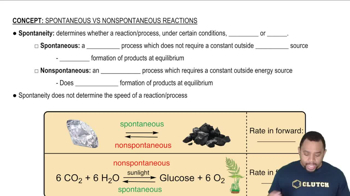
    Property describing whether a process can occur naturally under given conditions without continuous external energy.
  • Thermodynamics

    Branch of science concerned with energy changes and the direction of chemical processes, determining possibility but not speed.
  • Kinetics

    Field focusing on the rate at which chemical reactions proceed, independent of whether they occur naturally.
  • Equilibrium

    State where the forward and reverse reactions occur at equal rates, with no net change in concentrations of reactants and products.
  • Product Formation

    Tendency of a reaction to yield substances resulting from the transformation of reactants, favored in certain processes.
  • Reactant Favorability

    Condition where a process tends to remain in its original substances rather than forming new ones.
  • Free-Energy Change (ΔG)

    Thermodynamic quantity indicating whether a process can occur spontaneously under constant temperature and pressure.
  • Enthalpy (ΔH)

    Measure of total heat content in a system, influencing whether a process is energetically favorable.
  • Entropy (ΔS)

    Measure of disorder or randomness in a system, affecting the likelihood of a process occurring naturally.
  • Photosynthesis

    Process in which carbon dioxide and water are converted to glucose and oxygen, requiring sunlight as an energy source.
  • Cellular Respiration

    Natural process where glucose and oxygen are transformed into carbon dioxide and water, releasing energy.
  • Outside Energy Source

    Continuous input, such as sunlight or heat, required for certain processes to proceed that would not occur naturally.
  • Natural Process

    Event or reaction that proceeds without ongoing external energy, often favoring product formation.
  • Unnatural Process

    Event or reaction that does not proceed without continuous external energy, typically favoring reactants.
  • Reaction Rate

    Speed at which reactants are converted to products, unrelated to whether the process is spontaneous.