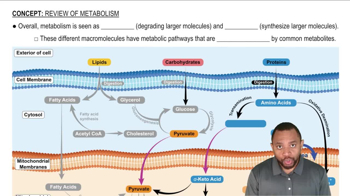
What are the two main categories of metabolism discussed in the video?
The two main categories are catabolic (degradation of larger molecules) and anabolic (synthesis of larger molecules) processes.
Which macromolecules are the focus of the metabolic pathway review in this lesson?
The focus is on carbohydrates and proteins, with lipids largely excluded due to minimal overlap.
What do black, green, and purple arrows represent in the metabolic diagrams?
Black arrows represent catabolic pathways, green arrows represent anabolic pathways, and purple arrows indicate transport across mitochondrial membranes.
What is the end product of carbohydrate digestion before entering glycolysis?
The end product is glucose.
What molecule is produced from glucose during glycolysis?
Pyruvate is produced from glucose during glycolysis.
After glycolysis, what are the two main fates of pyruvate?
Pyruvate can either be converted to acetyl CoA or enter the citric acid cycle directly.
How are proteins digested and what are their primary breakdown products?
Proteins are digested into amino acids.
What are the two main processes amino acids can undergo after entering the cell?
Amino acids can undergo transamination to form alpha-keto acids or oxidative deamination.
How do alpha-keto acids link protein and carbohydrate metabolism?
Alpha-keto acids can be converted into pyruvate or acetyl CoA, linking protein metabolism to carbohydrate metabolism.
What is the main waste product of the urea cycle?
The main waste product is urea, which is excreted in urine.
Which reactions of the urea cycle occur in the mitochondrial matrix?
Only reaction 1 of the urea cycle occurs in the mitochondrial matrix.
Where do reactions 2, 3, and 4 of the urea cycle take place?
Reactions 2, 3, and 4 occur in the cytosol.
Which two metabolites connect the urea cycle and the citric acid cycle?
Aspartate and fumarate connect the urea cycle and the citric acid cycle.
How does aspartate enter the urea cycle?
Aspartate enters during reaction 2 of the urea cycle, coming from the citric acid cycle.
What is the significance of fumarate in the connection between protein and carbohydrate metabolism?
Fumarate is produced in the urea cycle and can feed into the citric acid cycle, linking protein and carbohydrate metabolism.