GOB Chemistry
My Course
Learn
Exam Prep
AI Tutor
Study Guides
Textbook Solutions
Flashcards
Explore
Try the app
My Course
Learn
Exam Prep
AI Tutor
Study Guides
Textbook Solutions
Flashcards
Explore
Try the app
Back
Review of Metabolism definitions
You can tap to flip the card.
Metabolism
You can tap to flip the card.
👆
Metabolism
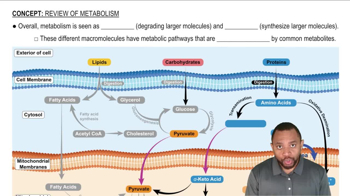
Network of chemical processes in cells, divided into breakdown and synthesis pathways, enabling energy production and molecule construction.
Track progress
Control buttons has been changed to "navigation" mode.
1/15
Related flashcards
Related practice
Recommended videos
Review of Metabolism quiz
Review of Metabolism
15 Terms
Review of Metabolism
25. Protein and Amino Acid Metabolism
5 problems
Topic

Laura
The Urea Cycle
25. Protein and Amino Acid Metabolism
2 problems
Topic
Nicole
25. Protein and Amino Acid Metabolism
6 topics
12 problems
Chapter
KeyshawnDavis
Guided course
7:15
Review of Metabolism Concept 1
2
views
Guided course
1:33
Review of Metabolism Example 1
1
views
Terms in this set (15)
Hide definitions
Metabolism
Network of chemical processes in cells, divided into breakdown and synthesis pathways, enabling energy production and molecule construction.
Catabolic Pathway
Sequence of reactions that degrade larger molecules into smaller units, releasing energy for cellular activities.
Anabolic Pathway
Series of reactions that build complex molecules from simpler ones, typically requiring energy input.
Carbohydrate
Macromolecule digested to glucose, serving as a primary energy source and linking to other metabolic pathways.
Protein
Macromolecule broken down into amino acids, which can enter energy-producing or nitrogen-removal pathways.
Glycolysis
Cytosolic process converting glucose to pyruvate, forming a central link in energy metabolism.
Pyruvate
Three-carbon metabolite at the crossroads of carbohydrate and amino acid metabolism, feeding into multiple pathways.
Acetyl CoA
Two-carbon molecule entering the citric acid cycle, produced from both carbohydrate and protein breakdown.
Citric Acid Cycle
Mitochondrial pathway oxidizing acetyl groups, generating energy carriers and connecting various metabolic routes.
Amino Acid
Building block of proteins, capable of conversion into energy intermediates or nitrogenous waste.
Transamination
Reaction transferring amino groups, forming alpha-keto acids and linking protein to carbohydrate metabolism.
Oxidative Deamination
Process removing amino groups from amino acids, producing ammonia for nitrogen disposal.
Urea Cycle
Series of reactions converting toxic ammonia into a safe, excretable compound, with steps in both mitochondria and cytosol.
Aspartate
Amino acid acting as a nitrogen donor in the urea cycle and connecting to the citric acid cycle.
Fumarate
Intermediate produced in the urea cycle, feeding into the citric acid cycle and linking protein and carbohydrate metabolism.