Back

Reduction of Monosaccharides quiz

Control buttons has been changed to "navigation" mode.
1/15
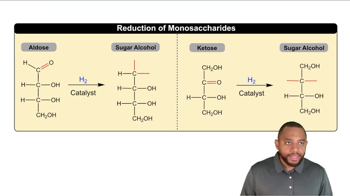
  • What happens to the carbonyl group during the reduction of an aldose or keto sugar?

    The carbonyl group is converted to a hydroxyl (OH) group, forming a sugar alcohol.
  • What reducing agent is commonly used in the reduction of monosaccharides?

    Hydrogen gas (H2) is commonly used as the reducing agent.
  • Which metal catalysts facilitate the reduction of monosaccharides?

    Nickel, platinum, and palladium are used as metal catalysts.
  • What is a sugar alcohol in terms of its structure?

    A sugar alcohol is a monosaccharide where all carbons are connected to hydroxyl groups.
  • What happens to the carbonyl oxygen during the reduction process?

    The carbonyl oxygen gains a hydrogen atom during reduction.
  • What happens to the carbonyl carbon during the reduction process?

    The carbonyl carbon also gains a hydrogen atom during reduction.
  • What is the result of reducing an aldose sugar?

    Reducing an aldose sugar produces a sugar alcohol.
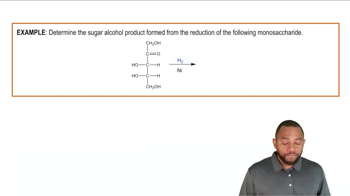
  • What is the result of reducing a ketose sugar?

    Reducing a ketose sugar also produces a sugar alcohol.
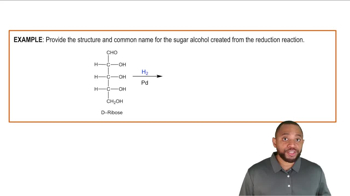
  • How are sugar alcohols named compared to their original sugars?

    The ending of the original sugar name changes from 'ose' to 'itol' to indicate a sugar alcohol.
  • What does the suffix '-itol' signify in sugar alcohol names?

    The suffix '-itol' signifies that the compound is a sugar alcohol.
  • What is the main structural difference between a monosaccharide and its reduced form?

    The reduced form has all carbons attached to hydroxyl groups, unlike the original carbonyl group.
  • What is the purpose of using a metal catalyst in the reduction of monosaccharides?

    Metal catalysts speed up the reduction reaction by facilitating hydrogen addition.
  • What group is formed when the carbonyl group is reduced?

    A hydroxyl (OH) group is formed from the reduction of the carbonyl group.
  • What is the similarity in the reduction process for aldose and ketose sugars?

    Both undergo reduction of the carbonyl group to form sugar alcohols.
  • Why do sugar alcohols have the suffix '-itol' instead of '-ose'?

    The suffix '-itol' reflects the transformation from a carbonyl group to an alcohol group.