Back

Reduction of Monosaccharides definitions

Control buttons has been changed to "navigation" mode.
1/14
  • Aldose

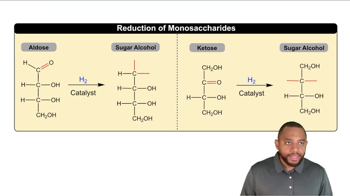
    A monosaccharide containing a carbonyl group at the end of its carbon chain, making it an aldehyde sugar.
  • Keto Sugar

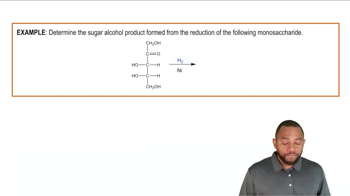
    A monosaccharide with a carbonyl group located within the carbon chain, classifying it as a ketone sugar.
  • Carbonyl Group

    A functional group composed of a carbon atom double-bonded to an oxygen atom, present in sugars before reduction.
  • Hydroxyl Group

    A functional group consisting of an oxygen and hydrogen atom, attached to each carbon in sugar alcohols.
  • Reducing Agent

    A substance, such as hydrogen gas, that donates electrons or hydrogen atoms to facilitate the conversion of carbonyl to alcohol.
  • Metal Catalyst

    A substance like nickel, platinum, or palladium that accelerates the reduction of sugars without being consumed.
  • Sugar Alcohol

    A monosaccharide derivative where every carbon atom is bonded to a hydroxyl group, formed by reduction.
  • Monosaccharide

    A simple sugar molecule serving as the basic unit for carbohydrates, subject to reduction in these reactions.
  • Naming Convention

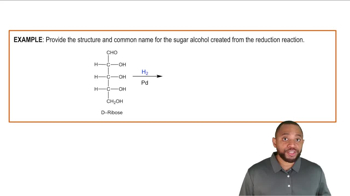
    A systematic method where the suffix of a sugar changes from 'ose' to 'itol' after reduction to an alcohol.
  • Hydrogenation

    A chemical process involving the addition of hydrogen atoms to a molecule, key in reducing sugars.
  • Platinum

    A metal catalyst used to speed up the reduction of monosaccharides in the presence of hydrogen.
  • Nickel

    A transition metal acting as a catalyst in the conversion of carbonyl groups to hydroxyl groups in sugars.
  • Palladium

    A metallic element serving as a catalyst to facilitate the reduction of aldose and keto sugars.
  • Sugar Alcohol Formation

    A transformation where all carbons in a monosaccharide become attached to hydroxyl groups through reduction.