Skip to main content
GOB Chemistry
My Course
Learn
Exam Prep
AI Tutor
Study Guides
Textbook Solutions
Flashcards
Explore
Try the app
My Course
Learn
Exam Prep
AI Tutor
Study Guides
Textbook Solutions
Flashcards
Explore
Try the app
Back
Reduction of Aldehydes and Ketones quiz
You can tap to flip the card.
What is the main goal of reducing aldehydes and ketones?
You can tap to flip the card.
👆
What is the main goal of reducing aldehydes and ketones?
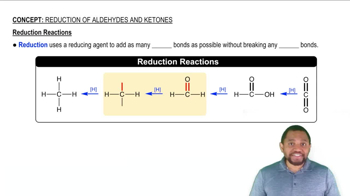
The main goal is to add as many carbon-hydrogen bonds as possible without breaking any carbon-carbon bonds.
Track progress
Control buttons has been changed to "navigation" mode.
1/15
Related flashcards
Related practice
Recommended videos
Reduction of Aldehydes and Ketones definitions
Reduction of Aldehydes and Ketones
15 Terms
Reduction of Aldehydes and Ketones
15. Aldehydes and Ketones
5 problems
Topic
Jules
Hemiacetal and Acetal Formation
15. Aldehydes and Ketones
1 problem
Topic
Laura
15. Aldehydes and Ketones
5 topics
13 problems
Chapter
Jules
Guided course
1:57
Reduction of Aldehydes and Ketones Concept 2
1
views
Guided course
2:38
Reduction Reactions Concept 1
1
views
Guided course
1:52
Reduction of Aldehydes and Ketones Example 1
1
views
Terms in this set (15)
Hide definitions
What is the main goal of reducing aldehydes and ketones?
The main goal is to add as many carbon-hydrogen bonds as possible without breaking any carbon-carbon bonds.
What is the most oxidized form of carbon mentioned in the reduction process?
The most oxidized form of carbon is carbon dioxide (CO2).
What does reduction of an aldehyde produce?
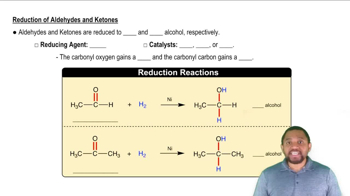
Reduction of an aldehyde produces a primary alcohol.
What does reduction of a ketone produce?
Reduction of a ketone produces a secondary alcohol.
Which reducing agent is commonly used for reducing aldehydes and ketones?
Hydrogen gas (H2) is commonly used as the reducing agent.
Name three metal catalysts that can facilitate the reduction of aldehydes and ketones.
Nickel (Ni), platinum, and palladium are used as metal catalysts.
During reduction, where do the two hydrogen atoms from H2 go?
One hydrogen atom adds to the carbonyl carbon and the other to the oxygen.
What bond is broken during the reduction of a carbonyl group?
A carbon-oxygen double bond is broken during the reduction.
What happens to the carbonyl carbon during reduction?
The carbonyl carbon gains a hydrogen atom.
What happens to the carbonyl oxygen during reduction?
The carbonyl oxygen gains a hydrogen atom.
What is the final product if reduction continues past the alcohol stage?
If reduction continues, the final product can be an alkane.
Why does carbon need to form a new bond with hydrogen during reduction?
Carbon needs to maintain four bonds, so it forms a new bond with hydrogen after the carbon-oxygen bond is broken.
What type of alcohol is formed from the reduction of an aldehyde?
A primary alcohol is formed from the reduction of an aldehyde.
What type of alcohol is formed from the reduction of a ketone?
A secondary alcohol is formed from the reduction of a ketone.
What is the role of metal catalysts like nickel in the reduction process?
Metal catalysts like nickel help facilitate the reduction reaction by enabling the addition of hydrogen.
 BackBack

 1:57
1:57