Skip to main content
GOB Chemistry
My Course
Learn
Exam Prep
AI Tutor
Study Guides
Textbook Solutions
Flashcards
Explore
Try the app
My Course
Learn
Exam Prep
AI Tutor
Study Guides
Textbook Solutions
Flashcards
Explore
Try the app
Back
Reduction of Aldehydes and Ketones definitions
You can tap to flip the card.
Reduction
You can tap to flip the card.
👆
Reduction
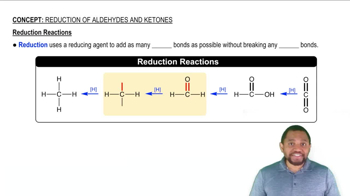
Process of increasing carbon-hydrogen bonds in a molecule without altering carbon-carbon bonds.
Track progress
Control buttons has been changed to "navigation" mode.
1/15
Related flashcards
Related practice
Recommended videos
Reduction of Aldehydes and Ketones quiz
Reduction of Aldehydes and Ketones
15 Terms
Reduction of Aldehydes and Ketones
15. Aldehydes and Ketones
5 problems
Topic
Jules
Hemiacetal and Acetal Formation
15. Aldehydes and Ketones
1 problem
Topic
Laura
15. Aldehydes and Ketones
5 topics
13 problems
Chapter
Jules
Guided course
1:57
Reduction of Aldehydes and Ketones Concept 2
1
views
Guided course
2:38
Reduction Reactions Concept 1
1
views
Guided course
1:52
Reduction of Aldehydes and Ketones Example 1
1
views
Terms in this set (15)
Hide definitions
Reduction
Process of increasing carbon-hydrogen bonds in a molecule without altering carbon-carbon bonds.
Aldehyde
Compound featuring a carbonyl group bonded to at least one hydrogen and one carbon atom.
Ketone
Compound with a carbonyl group bonded to two carbon atoms.
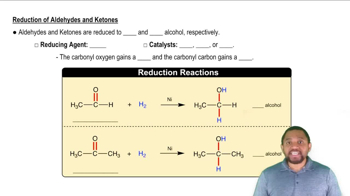
Primary Alcohol
Product formed when an aldehyde undergoes reduction, with the hydroxyl group attached to a terminal carbon.
Secondary Alcohol
Product formed when a ketone undergoes reduction, with the hydroxyl group attached to a non-terminal carbon.
Reducing Agent
Substance that donates hydrogen atoms to facilitate the conversion of carbonyl compounds to alcohols.
Hydrogen Gas
Molecular form of hydrogen (H2) commonly used to add hydrogen atoms during reduction reactions.
Metal Catalyst
Substance such as nickel, platinum, or palladium that accelerates the reduction of carbonyl compounds.
Carbonyl Group
Functional group consisting of a carbon atom double-bonded to an oxygen atom.
Carbon-Oxygen Double Bond
Bond in carbonyl compounds that is broken during reduction to allow hydrogen addition.
Carbon-Hydrogen Bond
Bond formed during reduction, increasing the hydrogen content of the carbon atom.
Carbon-Carbon Bond
Bond between two carbon atoms, preserved during the reduction of aldehydes and ketones.
Alkane
Fully reduced hydrocarbon with only single bonds, representing the final stage of reduction.
Nickel
Transition metal often used as a catalyst to facilitate hydrogen addition in reduction reactions.
Palladium
Transition metal catalyst that enhances the efficiency of hydrogenation in organic reductions.
 BackBack

 1:57
1:57