Skip to main content
GOB Chemistry
My Course
Learn
Exam Prep
AI Tutor
Study Guides
Textbook Solutions
Flashcards
Explore
Try the app
My Course
Learn
Exam Prep
AI Tutor
Study Guides
Textbook Solutions
Flashcards
Explore
Try the app
Back
Reactions of Thiols quiz
You can tap to flip the card.
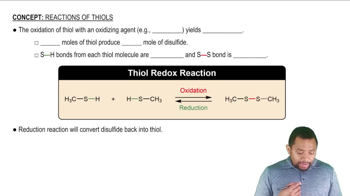
What is the product when a thiol is oxidized with bromine water?
You can tap to flip the card.
👆
What is the product when a thiol is oxidized with bromine water?
The product is a disulfide.
Track progress
Control buttons has been changed to "navigation" mode.
1/15
Related flashcards
Related practice
Recommended videos
Reactions of Thiols definitions
Reactions of Thiols
12 Terms
Reactions of Thiols
14. Compounds with Oxygen or Sulfur
2 problems
Topic
Jules
Alcohol Reactions: Oxidation Reactions
14. Compounds with Oxygen or Sulfur
5 problems
Topic
Jules
14. Compounds with Oxygen or Sulfur
7 topics
15 problems
Chapter
Jules
Guided course
0:53
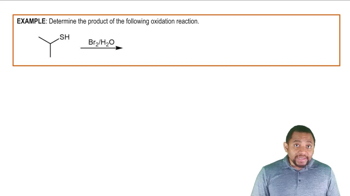
Reactions of Thiols Example 1
2
views
Guided course
1:49
Thiol Redox Reaction Concept 1
2
views
Terms in this set (15)
Hide definitions
What is the product when a thiol is oxidized with bromine water?
The product is a disulfide.
How many moles of thiol are needed to produce one mole of disulfide in oxidation?
Two moles of thiol are needed to produce one mole of disulfide.
What bond is formed between sulfur atoms during the oxidation of thiols?
An S–S (disulfide) bond is formed between the sulfur atoms.
What happens to the SH bonds in thiol molecules during oxidation?
The SH bonds are broken during oxidation.
What is lost from the sulfur atoms during the oxidation of thiols?
Hydrogen atoms are lost from the sulfur atoms.
What does oxidation mean in the context of thiols?
Oxidation means the gaining of oxygen or the loss of hydrogen.
What is the reverse process of oxidation for disulfides?
The reverse process is reduction.
What happens to the S–S bond during reduction?
The S–S bond is broken during reduction.
What is added to sulfur atoms during the reduction of a disulfide?
Hydrogen atoms are added to the sulfur atoms.
What does reduction mean in the context of thiols and disulfides?
Reduction means the addition of hydrogen.
What is the shorthand notation for oxidation in chemical reactions?
Oxidation is sometimes written as 'O'.
What is the shorthand notation for reduction in chemical reactions?
Reduction is sometimes written as 'H'.
How are thiols converted to disulfides?
Thiols are converted to disulfides by oxidation.
How are disulfides converted back to thiols?
Disulfides are converted back to thiols by reduction.
Why do sulfur atoms bond with each other during thiol oxidation?
They bond to make up for the loss of hydrogen and form a stable S–S bond.
 BackBack
 0:53
0:53