Skip to main content
GOB Chemistry
My Course
Learn
Exam Prep
AI Tutor
Study Guides
Textbook Solutions
Flashcards
Explore
Try the app
My Course
Learn
Exam Prep
AI Tutor
Study Guides
Textbook Solutions
Flashcards
Explore
Try the app
Back
Reactions of Thiols definitions
You can tap to flip the card.
Thiol
You can tap to flip the card.
👆
Thiol
A molecule containing an SH group bonded to a carbon, capable of undergoing oxidation to form disulfides.
Track progress
Control buttons has been changed to "navigation" mode.
1/12
Related flashcards
Related practice
Recommended videos
Reactions of Thiols quiz
Reactions of Thiols
15 Terms
Reactions of Thiols
14. Compounds with Oxygen or Sulfur
2 problems
Topic
Jules
Alcohol Reactions: Oxidation Reactions
14. Compounds with Oxygen or Sulfur
5 problems
Topic
Jules
14. Compounds with Oxygen or Sulfur
7 topics
15 problems
Chapter
Jules
Guided course
0:53
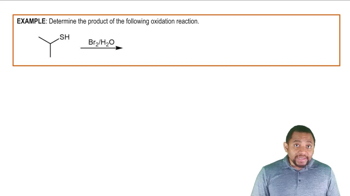
Reactions of Thiols Example 1
2
views
Guided course
1:49
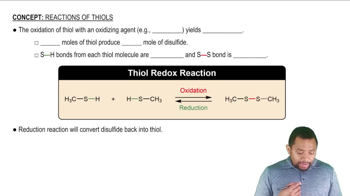
Thiol Redox Reaction Concept 1
2
views
Terms in this set (12)
Hide definitions
Thiol
A molecule containing an SH group bonded to a carbon, capable of undergoing oxidation to form disulfides.
Disulfide
A compound featuring an SS bond formed by the oxidation of two thiol molecules, linking two sulfur atoms.
Oxidation
A process involving the loss of hydrogen or gain of oxygen, converting thiols into disulfides by forming SS bonds.
Reduction
A reaction characterized by the addition of hydrogen, breaking SS bonds in disulfides to regenerate SH bonds in thiols.
SH Bond
A single bond between sulfur and hydrogen in thiols, broken during oxidation to form disulfides.
SS Bond
A covalent linkage between two sulfur atoms, created during the oxidation of thiols to form disulfides.
Bromine Water
An aqueous solution of Br2, commonly used as an oxidizing agent to convert thiols into disulfides.
Oxidizing Agent
A substance, such as bromine water, that facilitates the oxidation of thiols by accepting electrons or hydrogen.
Hydrogen Atom
A component lost from sulfur during oxidation of thiols, its removal enables SS bond formation.
Sulfur Atom
An element present in thiols and disulfides, forms new bonds during oxidation and reduction reactions.
Shorthand Notation
A symbolic representation where 'O' stands for oxidation and 'H' for reduction in reaction schemes.
Mole
A unit representing the amount of substance; two are required for thiols to form one disulfide in oxidation.
 BackBack
 0:53
0:53