Back

Rate of Reaction quiz

Control buttons has been changed to "navigation" mode.
1/15
  • What is chemical kinetics?

    Chemical kinetics is the study of reaction rates, focusing on how fast reactants convert into products over time.
  • What does the term 'rate' refer to in chemical reactions?

    Rate refers to the speed at which reactants are converted into products in a chemical reaction.
  • How can reaction rates be observed?

    Reaction rates can be observed by monitoring changes in the concentrations of reactants and products over time.
  • What happens to reactants and products when a reaction reaches completion?

    When a reaction reaches completion, almost all reactants are used up and only products remain.
  • What is the difference between a reaction that goes to completion and one that reaches equilibrium?

    A reaction that goes to completion uses a single forward arrow and consumes all reactants, while a reaction at equilibrium uses double arrows and has both reactants and products present.
  • What must happen for molecules to react with each other?

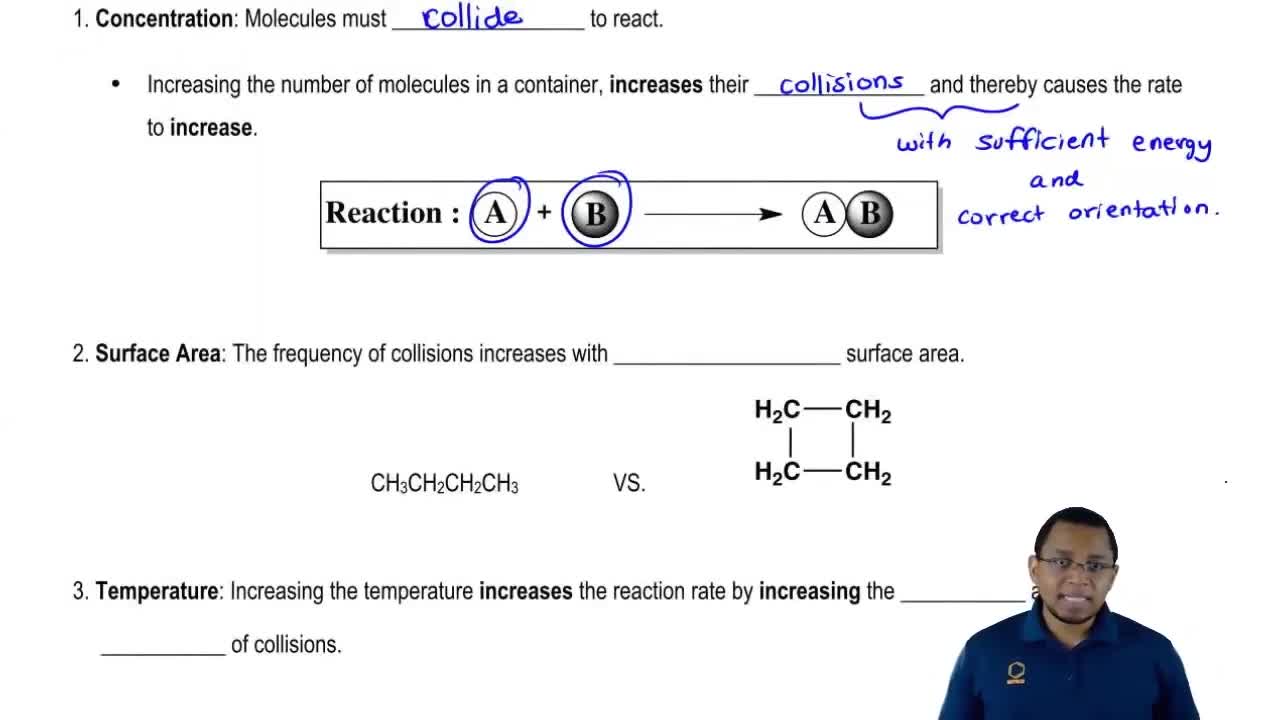
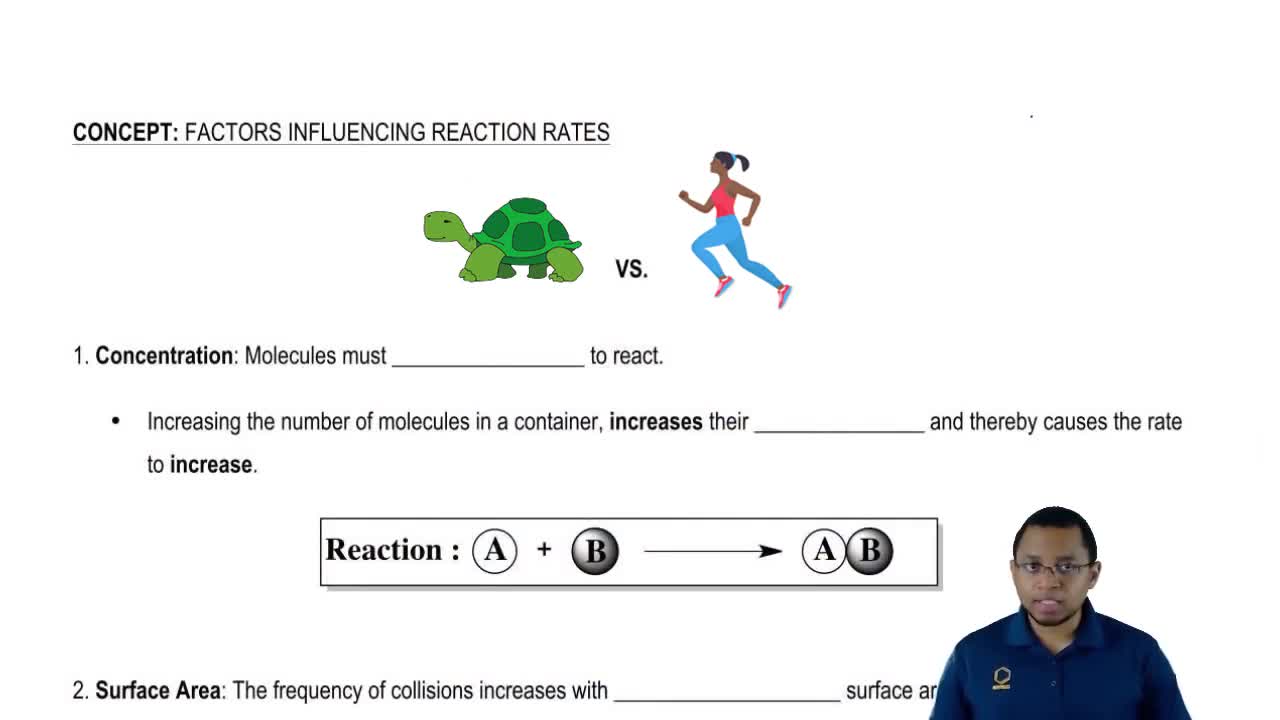
    Molecules must collide with sufficient energy and in the correct orientation for a reaction to occur.
  • How does increasing concentration affect the rate of reaction?

    Increasing concentration increases the number of collisions between molecules, which raises the likelihood of a reaction.
  • Why does greater surface area speed up a reaction?

    Greater surface area allows more frequent collisions between reactant molecules, increasing the reaction rate.
  • How does the structure of a molecule affect its surface area and reaction rate?

    Linear molecules have more surface area and react faster than cyclic or highly branched molecules.
  • What effect does temperature have on reaction rate?

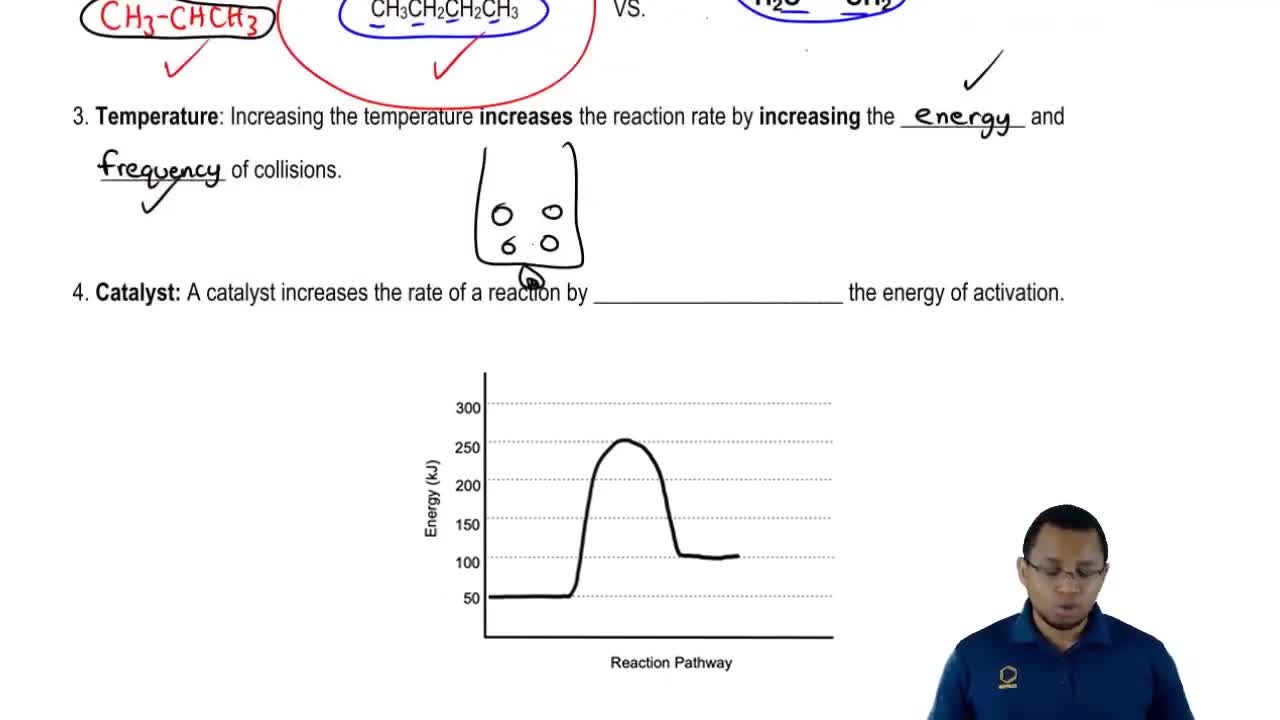
    Increasing temperature raises the energy and frequency of molecular collisions, which speeds up the reaction.
  • What is the role of a catalyst in a chemical reaction?

    A catalyst increases the reaction rate by lowering the activation energy required for the reaction to proceed.
  • What is the activation energy in a chemical reaction?

    Activation energy is the minimum energy required for reactants to reach the transition state and form products.
  • How does a catalyst change the reaction pathway?

    A catalyst provides an alternative pathway with a lower activation energy, making it easier for reactants to become products.
  • What are the four main factors that influence the rate of a chemical reaction?

    The four main factors are concentration, surface area, temperature, and the presence of a catalyst.
  • Why is correct orientation important during molecular collisions?

    Correct orientation ensures that molecules collide at the right spots to form products; otherwise, they just bounce off each other.