Skip to main content
GOB Chemistry
My Course
Learn
Exam Prep
AI Tutor
Study Guides
Textbook Solutions
Flashcards
Explore
Try the app
My Course
Learn
Exam Prep
AI Tutor
Study Guides
Textbook Solutions
Flashcards
Explore
Try the app
Back
Properties of Alcohols quiz
You can tap to flip the card.
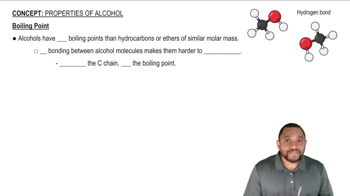
Why do alcohols have higher boiling points than hydrocarbons or ethers of similar molar mass?
You can tap to flip the card.
👆
Why do alcohols have higher boiling points than hydrocarbons or ethers of similar molar mass?
Alcohols have higher boiling points due to hydrogen bonding, which makes their molecules harder to separate.
Track progress
Control buttons has been changed to "navigation" mode.
1/15
Related flashcards
Related practice
Recommended videos
Properties of Alcohols definitions
Properties of Alcohols
14 Terms
Naming Ethers
14. Compounds with Oxygen or Sulfur
5 problems
Topic
Jules
14. Compounds with Oxygen or Sulfur
7 topics
15 problems
Chapter
Jules
Guided course
0:56
Solubility Concept 2
4
views
Guided course
1:23
Boiling Point Concept 1
3
views
Guided course
1:21
Boiling Point Example 1
5
views
Terms in this set (15)
Hide definitions
Why do alcohols have higher boiling points than hydrocarbons or ethers of similar molar mass?
Alcohols have higher boiling points due to hydrogen bonding, which makes their molecules harder to separate.
What is hydrogen bonding in alcohols?
Hydrogen bonding is the attraction between the partially positive hydrogen atom and the partially negative oxygen atom in different alcohol molecules.
How does the length of the carbon chain affect the boiling point of alcohols?
The boiling point increases as the carbon chain lengthens because larger molecules have stronger London dispersion forces.
What functional group makes alcohols polar?
The hydroxyl (OH) group makes alcohols polar.
Why are many alcohols water soluble?
Many alcohols are water soluble because their polar hydroxyl group allows for hydrogen bonding with water molecules.
How does the number of carbon atoms in an alcohol affect its solubility?
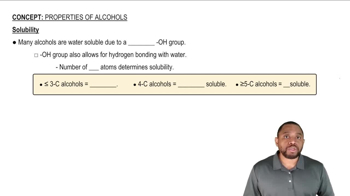
Alcohols with three or fewer carbons are soluble, four carbons are slightly soluble, and five or more carbons are insoluble in water.
What happens to alcohol solubility as more carbons are added to the chain?
As more carbons are added, alcohols become less soluble in water.
What is a diol?
A diol is an alcohol with two hydroxyl (OH) groups.
What is a triol?
A triol is an alcohol with three hydroxyl (OH) groups.
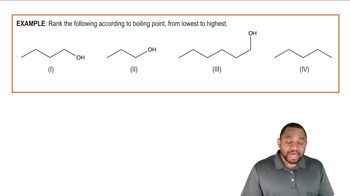
How do diols and triols compare to monohydric alcohols in terms of boiling point?
Diols and triols have higher boiling points than monohydric alcohols.
How do diols and triols compare to monohydric alcohols in terms of solubility?
Diols and triols are more soluble in water than monohydric alcohols.
Why are diols and triols more soluble than monohydric alcohols?
Multiple hydroxyl groups strengthen intermolecular forces and increase polarity, making them more soluble.
What intermolecular force is responsible for the high boiling point of alcohols?
Hydrogen bonding is responsible for the high boiling point of alcohols.
What effect does the hydroxyl group have on the physical properties of alcohols?
The hydroxyl group increases polarity and enables hydrogen bonding, affecting boiling point and solubility.
What is the relationship between functional groups and physical properties in organic chemistry?
Functional groups like hydroxyl influence physical properties such as boiling point and solubility through intermolecular forces.
 BackBack
 0:56
0:56